California LLC Operating Agreement: Complete Guide & Free Template
Everything you need to create a legally sound operating agreement for your California LLC, including templates and state-specific requirements.
Last updated: September 2026
California does not legally require an LLC operating agreement, but having one protects your limited liability status and sets the rules for ownership and profits. See exactly what to include below.
Affiliate disclosure: We may earn a commission at no extra cost to you.
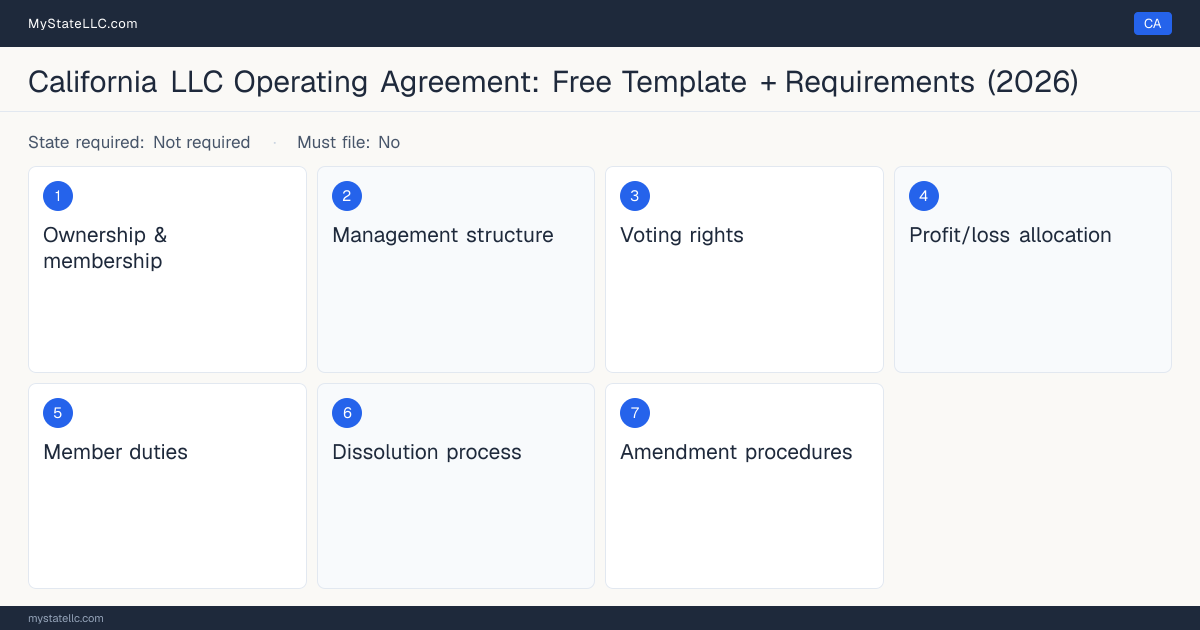
What a California operating agreement should contain, section by section. Source: California Secretary of State.Watch: California LLC Operating Agreement: Free Template + Requirements (2026)
State Requirements
Required By Law
No
Must Be Filed
No
Special Rules
California doesn't require LLCs to have operating agreements, but they're highly recommended. The agreement doesn't need to be filed with the California Secretary of State and can remain private.
What to Include in Your Operating Agreement
Ownership & membership
Define each member's ownership percentage and initial capital contributions. This section establishes who owns what portion of your California LLC and prevents future disputes over ownership stakes.
Management structure
Specify whether your LLC will be member-managed or manager-managed and outline day-to-day operational responsibilities. California law defaults to member-managed unless specified otherwise in your operating agreement.
Voting rights
Establish how decisions are made, including voting procedures and what percentage constitutes a majority. This prevents deadlocks and ensures smooth decision-making processes for your California LLC.
Profit/loss allocation
Detail how profits and losses will be distributed among members, which may differ from ownership percentages. This section matters for tax purposes and member expectations in California.
Member duties
Outline each member's responsibilities, restrictions, and obligations to the LLC. This includes fiduciary duties and prevents conflicts of interest that could harm your California business.
Dissolution process
Establish procedures for dissolving the LLC, including trigger events and asset distribution methods. California requires specific steps for dissolution, so having clear procedures protects all members' interests.
Amendment procedures
Define how the operating agreement can be modified in the future, including required approval thresholds. This ensures your agreement can evolve with your California LLC's changing needs.
Frequently Asked Questions
No, California doesn't legally require LLCs to have a written operating agreement. However, the California Secretary of State and legal experts strongly recommend creating one, as it provides critical protections you can't get otherwise.
Without an operating agreement, California law defaults to its standard LLC operating rules, which may not align with your business intentions. This creates three practical risks: (1) courts may ignore your limited liability protection if you lack documented governance structures, (2) member disputes over profit distribution, voting rights, and decision-making authority become costly to litigate, and (3) lenders and investors often refuse to work with LLCs lacking formal agreements.
An operating agreement documents your management structure, capital contributions, profit-sharing percentages, member responsibilities, and dissolution procedures. If you've multiple members, this is especially critical. It prevents one member from unilaterally making decisions or claiming unequal ownership stakes.
Your next step: Draft or download a California-compliant operating agreement immediately, have all members sign it, and store the executed copy with your LLC records. This single document prevents thousands in potential legal fees.
Yes, you can write your own California LLC operating agreement using templates or legal software without hiring an attorney. California law doesn't require you to file your operating agreement with the Secretary of State. It's an internal governance document. However, this freedom comes with risk: if your agreement is poorly drafted, California courts will default to the LLC Act's statutory rules, which may not reflect your intentions for profit distribution, member voting rights, or management structure. For single-member LLCs with straightforward ownership, a template is usually sufficient. For multi-member LLCs, those with significant assets exceeding $100,000, or complex capital contributions, consulting a California business attorney (typically $500 to $1,500 for review) ensures your agreement addresses dissolution procedures, buy-sell provisions, and liability protections that actually protect you. The practical implication: a flawed agreement could result in disputed ownership interests or unexpected tax consequences during disputes or member departures. Start by downloading a California-specific template from the Secretary of State's website, then have a local business attorney review it before any members sign.
No, California doesn't require LLC operating agreements to be notarized. Under the California Revised Uniform Limited Liability Company Act (Corporations Code § 17701.01 et seq.), your operating agreement is legally valid when signed by all members, regardless of notarization status. However, while notarization isn't mandatory, getting your agreement notarized creates a certified record that's harder to challenge in disputes and simplifies third-party verification, banks, lenders, and investors often request notarized copies as proof of member authority. Without notarization, you're relying solely on your original signatures, which could complicate future transactions if documents are lost or authenticity is questioned. If you decide to notarize, use any California notary public (available through your county clerk's office or online services); expect to pay $5 to $15 per signature. Your next step: have all members sign the operating agreement, then decide whether to visit a notary based on your anticipated business needs and lender requirements.
Without an operating agreement, your California LLC is automatically governed by the California Revised Uniform Limited Liability Company Act (Corporations Code § 17701.01 et seq.), which imposes rigid default rules that likely don't match your business intentions. This creates three serious problems: first, California law defaults to equal ownership and profit-sharing regardless of capital contributions, meaning a member who invested $100,000 has no more claim than one who invested nothing; second, all members gain equal management rights and can make unilateral business decisions without consent, exposing you to unauthorized contracts or asset sales; third, the state provides no default dispute resolution mechanism, forcing costly litigation through California courts to settle disagreements. Additionally, without a written agreement, the IRS may challenge your LLC's tax classification or member contributions. These gaps leave your personal assets potentially exposed and your business vulnerable to member conflicts. Download California's official LLC Operating Agreement template and have all members sign it immediately, then file a copy with your records, not with the Secretary of State, but keep it readily accessible for legal protection.
Yes, you can amend your California LLC operating agreement at any time by following the procedures specified in your original agreement. Most amendments require unanimous written consent from all members unless your agreement states otherwise. California law (under the California Uniform Limited Liability Company Act) doesn't mandate specific amendment procedures, so your agreement controls the process. However, if your agreement is silent on amendments, California defaults to requiring unanimous member approval. After approval, you should execute an Amendment to Operating Agreement and maintain it with your LLC records, though filing with the California Secretary of State isn't required unless your amendment affects information in your Articles of Organization. The practical implication: failure to properly amend creates potential disputes and leaves outdated terms in effect, exposing you to liability if decisions don't align with your documented agreement. To proceed, review your current operating agreement's amendment clause, obtain required member signatures, and consider consulting a California business attorney to ensure the amendment complies with your specific ownership structure and tax classification.
Sources
Each entry below is a document recorded in our verified California sources, and each entry says what the document is. Some statutory text is read from an accurate mirror rather than from the state's own host, and those say so.
See how Northwest Registered Agent, Bizee, ZenBusiness and LegalZoom, the formation services we partner with, compare on 3-year cost, BBB rating and Trustpilot score before you choose.