Protect your business with a comprehensive operating agreement. Get our free template plus step-by-step guidance for Delaware LLCs.
Last updated: September 2026
Delaware does not legally require an LLC operating agreement, but having one protects your limited liability status and sets the rules for ownership and profits. See exactly what to include below.
Affiliate disclosure: We may earn a commission at no extra cost to you.
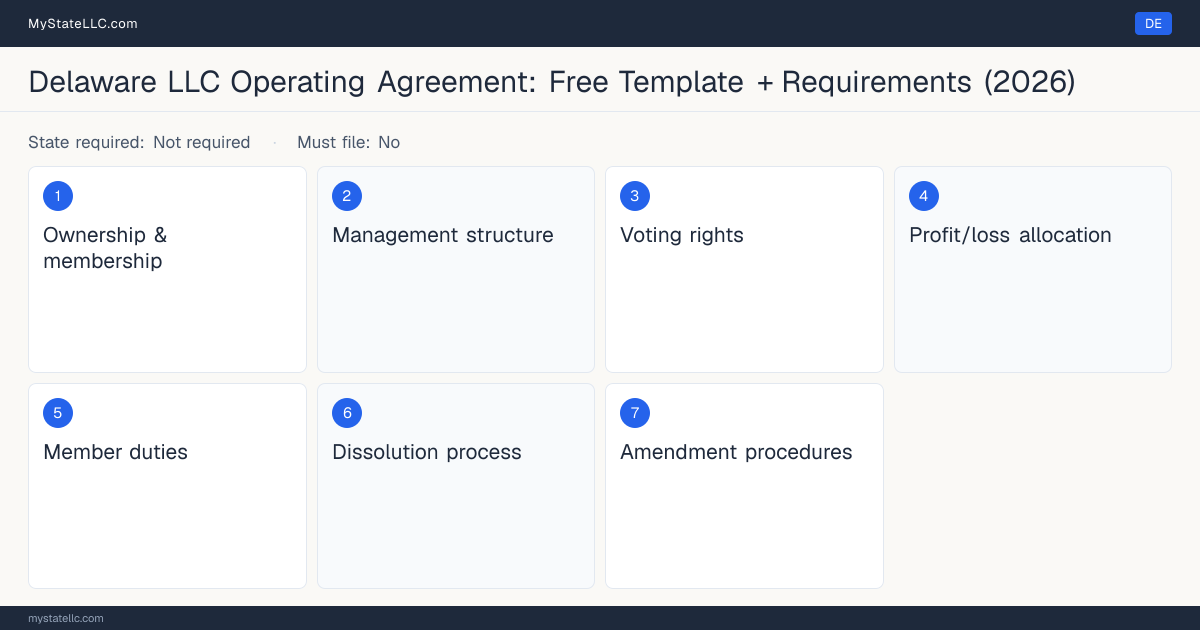
What a Delaware operating agreement should contain, section by section. Source: Delaware Division of Corporations.Watch: Delaware LLC Operating Agreement: Free Template + Requirements (2026)
State Requirements
Required By Law
no
Must Be Filed
no
Special Rules
Delaware law provides strong default protections for LLCs without operating agreements, but written agreements are still highly recommended to override default statutory provisions.
What to Include in Your Operating Agreement
Ownership & membership
Define each member's ownership percentage, capital contributions, and membership interests. This section establishes who owns what portion of the LLC and prevents future disputes.
Management structure
Specify whether your LLC is member-managed or manager-managed, and outline decision-making authority. Clear management structure prevents confusion about who can make binding decisions.
Voting rights
Establish voting procedures for major decisions, including what constitutes a quorum and required vote thresholds. This ensures smooth decision-making and protects minority interests.
Profit/loss allocation
Detail how profits and losses will be distributed among members, including timing and methods of distribution. This section directly impacts each member's tax obligations and returns.
Member duties
Outline each member's responsibilities, fiduciary duties, and any restrictions on competing businesses. Clear duties prevent conflicts and ensure everyone understands their obligations.
Dissolution process
Establish procedures for dissolving the LLC, including triggering events, asset distribution, and winding up operations. This protects members' interests if the business ends.
Amendment procedures
Define how the operating agreement can be modified, including required votes and documentation. This ensures the agreement can evolve with your business while maintaining member protections.
Frequently Asked Questions
No, Delaware doesn't legally require LLCs to have an operating agreement under Delaware Code Title 6, Chapter 18. However, this is misleading. You should treat it as mandatory for protection. Without a written agreement, the Delaware Limited Liability Company Act imposes default rules that may contradict your intentions: equal profit sharing regardless of capital contributions, member removal by majority vote, and automatic dissolution if a member leaves. This means if you've two members and disagree on distributions, state law defaults to 50/50 splits even if one invested significantly more. An operating agreement overrides these unfavorable defaults and documents critical decisions like management structure, capital calls, and buy-sell provisions. For Delaware LLCs taxed as S-corps or partnerships, the IRS treats a missing agreement as evidence of inadequate formalities, potentially piercing your liability shield during audits. The practical risk: litigation costs exceed the $200 to 500 cost of drafting a proper agreement. File your completed operating agreement with the Delaware Division of Corporations when you submit your Certificate of Formation, or maintain it with your registered agent for compliance verification. Review your agreement annually with a Delaware business attorney to ensure it reflects current member intentions.
Yes, you can draft your own Delaware LLC operating agreement without legal assistance. Delaware law doesn't require you to file your operating agreement with the Delaware Division of Corporations. It's an internal document only your LLC members need. However, this freedom comes with significant risk: poorly drafted agreements often lack critical provisions for member disputes, profit distribution, voting rights, and dissolution procedures, which can lead to costly litigation under Delaware's default statutory rules. If your LLC has multiple members or complex ownership structures, ambiguous language in your agreement could result in disputes costing thousands in legal fees to resolve. The practical implication is that while self-drafting saves upfront costs, it frequently costs far more when conflicts arise. Delaware courts strictly interpret operating agreements as written, leaving no room for "what we intended." Your next step is using a state-specific template that addresses Delaware's LLC Act requirements or consulting a Delaware business attorney to review your draft before execution. An investment that typically prevents exponentially larger expenses later.
No, Delaware doesn't require LLC operating agreements to be notarized under Delaware Code Title 6, Chapter 18. The agreement simply needs to be signed by all members to be legally valid. However, notarization is strongly recommended for practical reasons: it creates a presumption of signature authenticity that can protect you if a member later disputes whether they actually signed the document or claims their signature was forged. Without notarization, you may face costly litigation to prove the agreement's validity. Additionally, if your LLC needs to open a business bank account or secure financing, many banks and lenders request a notarized operating agreement as proof of the document's legitimacy. The Delaware Division of Corporations doesn't maintain copies of operating agreements, so notarization creates an official record through a Delaware notary public. To move forward, have all members sign the agreement, then take it to any Delaware notary public (available at most banks and UPS stores) for a minimal fee of $5 to 15 per signature to add this protective layer.
Without an operating agreement, your Delaware LLC will be governed by Delaware Code Title 6, Chapter 18, which applies default statutory rules to all management and ownership matters. This means the Delaware Division of Corporations will consider your LLC subject to state-mandated profit distribution (equal splits regardless of capital contributions), default management structure (member-managed unless otherwise filed), and predetermined member withdrawal rights. None of which may align with your actual business arrangement. Practically, this creates significant risk: if disputes arise between members, you've no written agreement to reference for resolving voting deadlocks, buyout terms, or liability protection structures. Additionally, lenders and investors typically require an operating agreement before extending credit or capital, and the IRS may challenge your LLC's tax classification if governance is unclear. Your next step is to draft and execute a Delaware LLC Operating Agreement immediately, ideally before conducting business, and retain a copy with your registered agent and company records. This document overrides statutory defaults and protects your ownership structure.
Yes, you can amend your Delaware LLC operating agreement at any time, but the process depends on what your original agreement specifies. If your operating agreement includes amendment procedures, such as a majority or supermajority vote requirement. You must follow those exact procedures. If no procedures are outlined, the safe course is unanimous written consent from all members before the agreement is amended.
This distinction matters significantly for LLC owners. A unanimity requirement means even one dissenting member can block amendments, potentially creating operational gridlock. Conversely, if your agreement permits amendments by majority vote, you retain flexibility to adapt to changing business circumstances without full member consensus.
After amending your operating agreement, file the Certificate of Amendment with the Delaware Division of Corporations (cost: $100) if the amendment affects your Certificate of Formation. Document the amendment in writing and distribute copies to all members immediately to ensure compliance and prevent future disputes over governing terms.
Sources
Each entry below is a document recorded in our verified Delaware sources, and each entry says what the document is. Some statutory text is read from an accurate mirror rather than from the state's own host, and those say so.
corp.delaware.govDelaware Division of Corporations: business entity filings
See how Northwest Registered Agent, Bizee, ZenBusiness and LegalZoom, the formation services we partner with, compare on 3-year cost, BBB rating and Trustpilot score before you choose.