Form an LLC for Your General Contracting Business in New Hampshire
Protect your personal assets from job-site accidents and property damage claims while unlocking valuable tax deductions for equipment and materials. Year one in New Hampshire costs $200 in mandatory state charges, then $100 a year.
Last updated: September 2026
Formation Services Compared
Ready to form your New Hampshire LLC?
Compare the formation services we partner with before you pay: pricing, registered agent renewal costs and BBB ratings side by side.
Affiliate disclosure: We may earn a commission at no extra cost to you.
Start your LLC with ZenBusiness$0 service fee plus your state's filing fee. Registered agent is extra: $99 for the first year when you form with them, then $199/yr.Form your LLC with Northwest ($39 + state fee)Includes a year of registered agent service. That enrolls you by default in annual report filing at $100 plus state fees, charged automatically to your saved payment method and cancellable any time.Not sure which service is right? Compare formation services →
Yes, forming an LLC is highly recommended for general contractors in New Hampshire due to significant liability protection and tax advantages.
General contractors face substantial risks from job-site accidents, property damage, and construction defects that could result in costly lawsuits. An LLC shields your personal assets from these business liabilities while providing credibility with clients and suppliers. Additionally, you'll gain access to valuable tax deductions for equipment, vehicles, and materials that can significantly reduce your tax burden.
Key Benefits of an LLC for New Hampshire
Personal Asset Protection from Construction Liability
Shields your home, personal savings, and vehicles from lawsuits related to job-site accidents, property damage, or construction defects that are common in the contracting industry.
Enhanced Credibility with Commercial Clients
Many property developers, commercial clients, and government contracts require contractors to be properly incorporated, giving your LLC a competitive advantage in bidding.
Tax Deductions for Equipment and Materials
Write off business expenses like tools, heavy equipment, construction materials, vehicle expenses, and subcontractor payments to significantly reduce your taxable income.
Simplified Business Banking and Financing
Establish business credit separate from your personal credit, making it easier to secure equipment loans, lines of credit, and better rates from suppliers.
Professional Licensing and Insurance Benefits
Maintain your contractor's license under the LLC structure and potentially access better commercial liability insurance rates through business entity status.
How to Form Your LLC
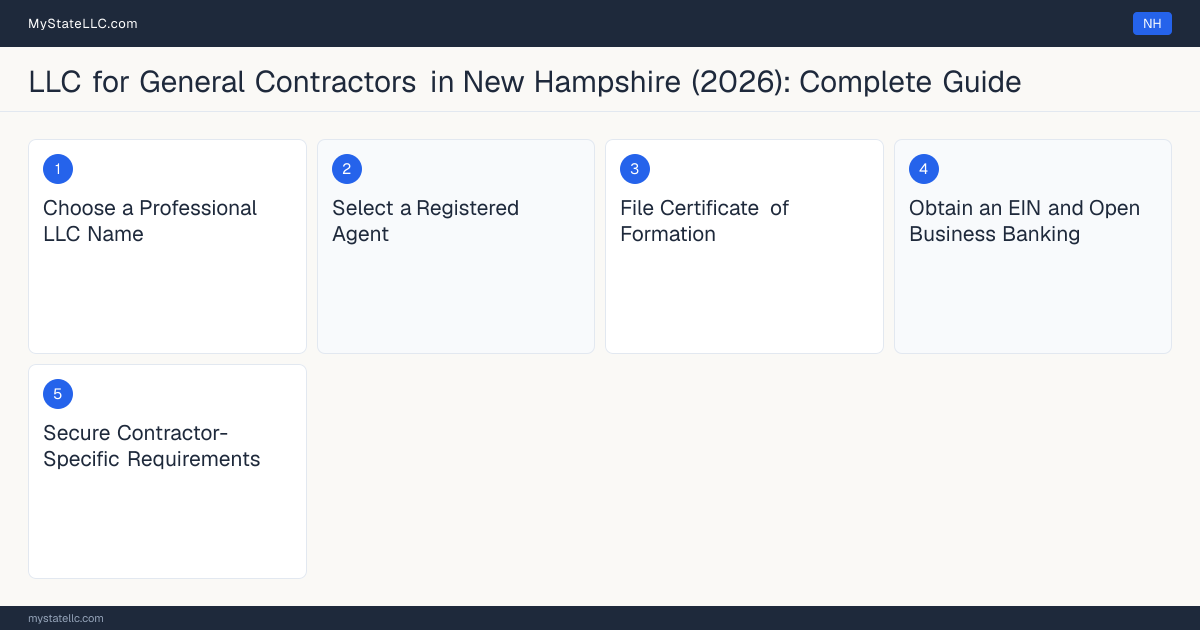
- 1
Choose a Professional LLC Name
Select a name that reflects your contracting specialty and includes 'LLC'. Avoid names too similar to existing businesses and ensure it complies with New Hampshire naming requirements. Consider including terms like 'Construction', 'Contracting', or your specialty (e.g., 'Roofing', 'Remodeling').
- 2
Select a Registered Agent
Choose a reliable registered agent with a New Hampshire address to receive legal documents. Many contractors use their business address, but a professional service ensures you don't miss important legal notices while on job sites.
- 3
File Certificate of Formation
Submit your Certificate of Formation to the New Hampshire Secretary of State with the $100 filing fee. Include your business purpose as construction/contracting services and specify member management structure.
- 4
Obtain an EIN and Open Business Banking
Get an Employer Identification Number from the IRS and open a dedicated business bank account. This separation matters for maintaining liability protection and tracking deductible business expenses like materials and equipment.
- 5
Secure Contractor-Specific Requirements
Update your contractor's license to reflect the LLC ownership, obtain appropriate commercial liability insurance, and ensure compliance with local building permit requirements under your new business structure.
Tax Considerations
Self Employment Tax
As a single-member LLC, you'll pay self-employment tax on your contracting income, but you can deduct the employer portion. Consider S-Corp election if your profits exceed $60,000 to potentially reduce SE tax on distributions.
Deductions
General contractors can deduct tools and heavy equipment, vehicle expenses and fuel costs, payments to subcontractors, construction materials and supplies, licensing and permit fees, commercial insurance premiums, and business-related travel between job sites.
State Taxes
New Hampshire has no state income tax on wages or business pass-through income, but does impose the Business Profits Tax (BPT) of 7.5% on LLC profits over $50,000 and the Business Enterprise Tax (BET) of 0.55% on enterprise value. LLCs file an annual report by April 1st ($100 fee). Net impact is favorable compared to states with high personal income taxes.
New Hampshire Licensing Requirements for General Contractors
New Hampshire issues no statewide license for this trade. Local registrations and specialty permits can still apply. New Hampshire has no state general contractor or home improvement contractor license. RSA 310:2, II enumerates every board within the Office of Professional Licensure and Certification and contains no contractor board, while individual trades are licensed: the Electricians' board under RSA 319-C, the Mechanical licensing board under RSA 153:27-a, and the Installation standards board under RSA 205-D. Municipalities issue building permits and may impose their own local requirements.
Do you need business insurance?
An LLC’s liability shield protects your personal assets from the business’s debts and lawsuits, but it does not protect the business itself, client injuries, property damage, and lawsuits against the company can still put its income and assets at risk.
Business insurance providers for general contractors
Typical cost for general contractors: general liability $162/mo median · professional liability $67/mo · limits $1M per occurrence / $2M aggregate (GL); $1M per occurrence / $1M aggregate (professional liability), as of September 2026, per Insureon - General Contractor Insurance Cost. These are industry-wide medians, not quotes from the providers below. No figure in this paragraph describes a policy offered by any provider below, and the limits shown are the basis of that median rather than terms offered by any of them.
Disclosure: NEXT Insurance (ERGO NEXT), Hiscox and Thimble pay us when you request a quote through our link, whether or not you buy a policy. Embroker does not pay us. This does not affect our editorial comparisons, and coverage details always come from the insurer's own documents.
| Provider | Stated focus | AM Best rating | Insurer’s site |
|---|---|---|---|
| NEXT Insurance (ERGO NEXT) | online small business insurance for the self-employed, freelancers, contractors, sole proprietors, and micro-businesses across 1,300+ professions | A+ | Visit NEXT Insurance (ERGO NEXT) |
| Hiscox | small-business and professional liability (errors & omissions) coverage for professional-services freelancers, consultants, and specialty professions across 180+ occupations | A | Visit Hiscox |
| Embroker | digital commercial insurance (D&O, cyber, tech E&O, EPLI, professional liability) for venture-funded startups, tech companies, law firms, VC/PE firms, and other professional-services businesses | N/A | Visit Embroker |
| Thimble | on-demand, short-term (hourly/daily/monthly) general liability and professional liability insurance for freelancers, gig workers, and small businesses across 129+ industries | N/A | Visit Thimble |
Stated focus reproduces how each insurer describes its own business on its own website. It is not our recommendation, and we do not rank these providers.
IncACA is not an insurance agency, producer, or broker, and is not licensed in any state. We do not sell, solicit, or negotiate insurance, we take no applications, and we do not quote, bind, or place coverage. Every quote is requested on the insurer’s own website. This guide is general information, not insurance, legal, or financial advice. Coverage needs, requirements, and pricing vary by business, location, and carrier underwriting. Confirm policy details directly with a licensed insurance carrier or agent before making a purchasing decision.
This guide is general information, not legal or tax advice, and reading it does not create an attorney-client relationship. Read the asset-protection claims on this page narrowly. An LLC separates the company’s own obligations from what you own personally, so a trade creditor, a commercial lease, a business loan without a personal guarantee, or a judgment against the company normally reaches the company rather than your home or savings. It does not put a wall around what you personally do: you remain personally answerable for your own negligent or wrongful acts, and forming an LLC does not shield you from a claim arising from work you did yourself. Liability insurance is what answers a claim like that, not the entity. You are also personally exposed on anything you sign a personal guarantee for, and on the payroll and sales taxes most states collect from responsible individuals. Whether the shield holds at all turns on facts this page cannot see, including how the company was capitalised, whether its money is kept separate from yours, and what your state’s courts have done with veil-piercing claims. Confirm your own position with an attorney licensed in your state, and your cover with a licensed insurance agent, before you rely on anything here.
Frequently Asked Questions
Ready to Form Your New Hampshire LLC?
Affiliate disclosure: We may earn a commission at no extra cost to you.
Start your LLC with ZenBusiness$0 service fee plus your state's filing fee. Registered agent is extra: $99 for the first year when you form with them, then $199/yr.Form your LLC with Northwest ($39 + state fee)Includes a year of registered agent service. That enrolls you by default in annual report filing at $100 plus state fees, charged automatically to your saved payment method and cancellable any time.Not sure which service is right? Compare formation services →