Form an LLC for Your Dental Practice in Massachusetts
Protect your assets, reduce self-employment taxes, and simplify practice ownership with the right business structure for Massachusetts dentists. Year one in Massachusetts costs $1040 in mandatory state charges, then $520 a year.
Last updated: September 2026
Formation Services Compared
Ready to form your Massachusetts LLC?
Compare the formation services we partner with before you pay: pricing, registered agent renewal costs and BBB ratings side by side.
Affiliate disclosure: We may earn a commission at no extra cost to you.
Start your LLC with ZenBusiness$0 service fee plus your state's filing fee. Registered agent is extra: $99 for the first year when you form with them, then $199/yr.Form your LLC with Northwest ($39 + state fee)Includes a year of registered agent service. That enrolls you by default in annual report filing at $100 plus state fees, charged automatically to your saved payment method and cancellable any time.Not sure which service is right? Compare formation services →
Yes, forming an LLC is highly beneficial for dentists in Massachusetts due to significant tax savings and liability protection.
An LLC keeps the practice's business debts, leases and vendor claims away from your personal assets, and it separates one member's exposure from another's. It does not shield you from a claim arising out of your own professional work, which is what professional liability insurance is for. LLCs also streamline practice acquisitions and make it easier to bring in associate dentists as members.
Key Benefits of an LLC for Massachusetts
Self-Employment Tax Savings
Elect S-Corp taxation to save thousands on the 15.3% self-employment tax by taking a reasonable salary and distributions. High-earning dentists typically save $10,000-$30,000 annually.
Malpractice Liability Protection
No entity shields a licensed professional from their own negligence. What the LLC does is stop a business creditor, a landlord or a claim against a co-member's work from reaching your personal assets, and professional liability cover answers the rest.
Simplified Practice Acquisition
Transfer ownership interests easily when buying or selling practices, and structure partnerships with other dentists through membership percentages rather than complex partnership agreements.
Insurance Credentialing Advantages
Many insurance companies prefer credentialing LLCs over sole proprietorships, and the business structure can facilitate smoother provider enrollment with dental insurance networks.
Associate Dentist Integration
Bring associate dentists into your practice as LLC members with defined ownership percentages, creating clear succession planning and profit-sharing arrangements.
How to Form Your LLC
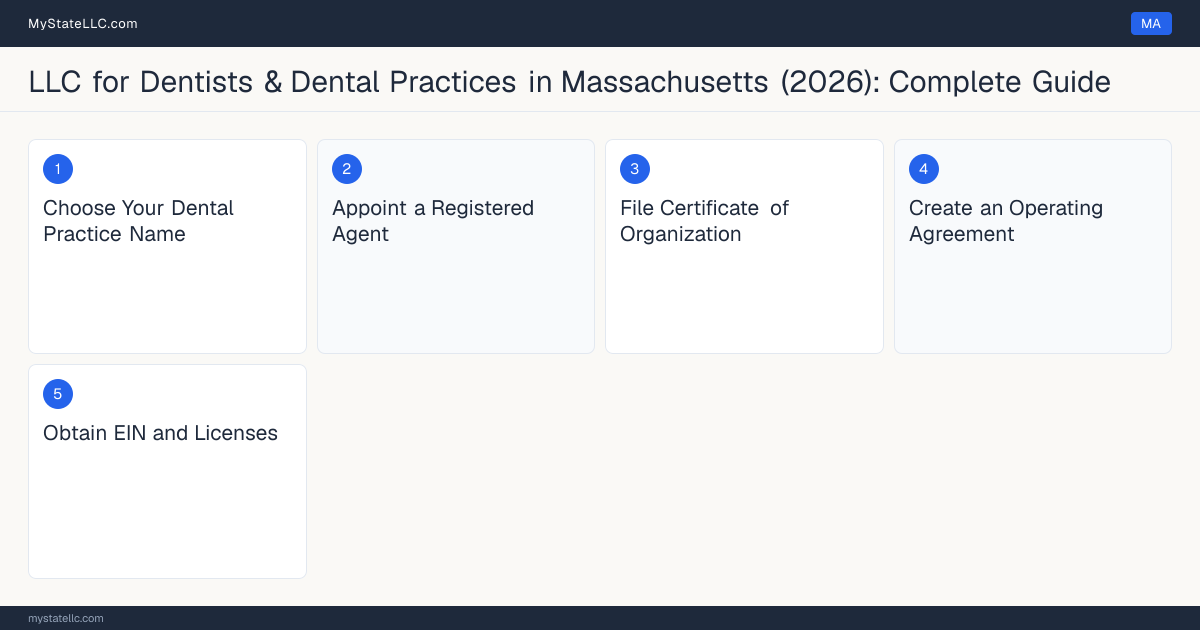
- 1
Choose Your Dental Practice Name
Select a name ending in 'LLC' that reflects your practice identity. Avoid names suggesting medical services beyond dentistry. Check availability through the Massachusetts Secretary of the Commonwealth, Corporations Division website and ensure the domain is available for your practice website.
- 2
Appoint a Registered Agent
Choose a registered agent to receive legal documents. Many dentists use their practice address, but a professional service ensures privacy and reliability, especially important when dealing with malpractice litigation or insurance matters.
- 3
File Certificate of Organization
Submit your Certificate of Organization to the Massachusetts Secretary of the Commonwealth, Corporations Division with the $500 filing fee. Include your practice purpose as 'dental services' and specify if you'll have multiple dentist members from the start. Massachusetts charges $500 to file the Certificate of Organization by mail or in person and $520 electronically, because a mandatory $20 expedite fee applies to an electronic filing; the annual report splits the same way.
- 4
Create an Operating Agreement
Draft an operating agreement addressing profit distribution, associate dentist buy-ins, patient record ownership, and succession planning. This matters for multi-dentist practices and protects your interests if bringing in partners later.
- 5
Obtain EIN and Licenses
Get an EIN from the IRS for tax purposes and banking. Update your dental license with the Massachusetts Board of Registration in Dentistry to reflect your new business structure, and notify insurance companies of the entity change.
Tax Considerations
Self Employment Tax
Massachusetts dentists can elect S-Corp taxation for their LLC to avoid self-employment tax on distributions above a reasonable salary. This typically saves $15,000-$40,000 annually for successful practices, but requires careful payroll management and reasonable compensation documentation.
Deductions
LLCs can deduct dental equipment purchases, dental supplies and lab fees, malpractice insurance premiums, continuing education costs, staff wages and benefits, office rent, and practice loan interest. Equipment purchases can be immediately expensed under Section 179 up to annual limits.
State Taxes
Massachusetts has a flat 5% personal income tax rate on LLC pass-through income. Massachusetts LLCs also owe an annual report fee of $500, one of the highest in the country. There's a minimum excise tax for LLCs that elect corporate tax treatment. Massachusetts requires LLCs to register for sales tax if selling taxable goods or services.
Massachusetts Licensing Requirements for Dentists & Dental Practices
In Massachusetts, Dentists & Dental Practices are regulated by the Massachusetts Board of Registration in Dentistry. A License to Practice Dentistry is required to practice legally. Note: Massachusetts may require a Professional LLC (PLLC) rather than a standard LLC. Check with the licensing board before filing your Certificate of Organization. Massachusetts allows dentists to form a Professional LLC under M.G.L. c. 156C § 2, with all members required to be licensed dentists. The Massachusetts Board of Registration in Dentistry, under the Division of Professional Licensure, licenses individuals; the PLLC is filed with the Massachusetts Secretary of the Commonwealth.
Do you need business insurance?
An LLC’s liability shield protects your personal assets from the business’s debts and lawsuits, but it does not protect the business itself, client injuries, property damage, and lawsuits against the company can still put its income and assets at risk.
Business insurance providers for dentists & dental practices
Typical cost for dentists & dental practices: general liability $37/mo median · professional liability $286/mo · limits $1M per occurrence / $2M aggregate (GL); $1M per occurrence / $3M aggregate (dental malpractice), as of September 2026, per Insureon - Dentist Insurance Cost. These are industry-wide medians, not quotes from the providers below. No figure in this paragraph describes a policy offered by any provider below, and the limits shown are the basis of that median rather than terms offered by any of them.
Disclosure: NEXT Insurance (ERGO NEXT), Hiscox and Thimble pay us when you request a quote through our link, whether or not you buy a policy. Embroker does not pay us. This does not affect our editorial comparisons, and coverage details always come from the insurer's own documents.
| Provider | Stated focus | AM Best rating | Insurer’s site |
|---|---|---|---|
| NEXT Insurance (ERGO NEXT) | online small business insurance for the self-employed, freelancers, contractors, sole proprietors, and micro-businesses across 1,300+ professions | A+ | Visit NEXT Insurance (ERGO NEXT) |
| Hiscox | small-business and professional liability (errors & omissions) coverage for professional-services freelancers, consultants, and specialty professions across 180+ occupations | A | Visit Hiscox |
| Embroker | digital commercial insurance (D&O, cyber, tech E&O, EPLI, professional liability) for venture-funded startups, tech companies, law firms, VC/PE firms, and other professional-services businesses | N/A | Visit Embroker |
| Thimble | on-demand, short-term (hourly/daily/monthly) general liability and professional liability insurance for freelancers, gig workers, and small businesses across 129+ industries | N/A | Visit Thimble |
Stated focus reproduces how each insurer describes its own business on its own website. It is not our recommendation, and we do not rank these providers.
IncACA is not an insurance agency, producer, or broker, and is not licensed in any state. We do not sell, solicit, or negotiate insurance, we take no applications, and we do not quote, bind, or place coverage. Every quote is requested on the insurer’s own website. This guide is general information, not insurance, legal, or financial advice. Coverage needs, requirements, and pricing vary by business, location, and carrier underwriting. Confirm policy details directly with a licensed insurance carrier or agent before making a purchasing decision.
This guide is general information, not legal or tax advice, and reading it does not create an attorney-client relationship. Read the asset-protection claims on this page narrowly. An LLC separates the company’s own obligations from what you own personally, so a trade creditor, a commercial lease, a business loan without a personal guarantee, or a judgment against the company normally reaches the company rather than your home or savings. It does not put a wall around what you personally do: you remain personally answerable for your own professional negligence, and forming an LLC does not shield a licensed practitioner from a malpractice or negligence claim arising from their own work. Professional liability cover (errors and omissions, or malpractice cover in some trades) is what answers a claim like that, not the entity. You are also personally exposed on anything you sign a personal guarantee for, and on the payroll and sales taxes most states collect from responsible individuals. Whether the shield holds at all turns on facts this page cannot see, including how the company was capitalised, whether its money is kept separate from yours, and what your state’s courts have done with veil-piercing claims. Confirm your own position with an attorney licensed in your state and with the board that licenses your trade, and confirm your cover with a licensed insurance agent, before you rely on anything here.
Frequently Asked Questions
Ready to Form Your Massachusetts LLC?
Affiliate disclosure: We may earn a commission at no extra cost to you.
Start your LLC with ZenBusiness$0 service fee plus your state's filing fee. Registered agent is extra: $99 for the first year when you form with them, then $199/yr.Form your LLC with Northwest ($39 + state fee)Includes a year of registered agent service. That enrolls you by default in annual report filing at $100 plus state fees, charged automatically to your saved payment method and cancellable any time.Not sure which service is right? Compare formation services →