LLC for Personal Trainers in Maine: Your Complete 2026 Guide
Protect yourself from client injury lawsuits, gain professional credibility with gyms, and open up valuable tax deductions for equipment and certifications. Year one in Maine costs $260 in mandatory state charges, then $85 a year.
Last updated: September 2026
Formation Services Compared
Ready to form your Maine LLC?
Compare the formation services we partner with before you pay: pricing, registered agent renewal costs and BBB ratings side by side.
Affiliate disclosure: We may earn a commission at no extra cost to you.
Start your LLC with ZenBusiness$0 service fee plus your state's filing fee. Registered agent is extra: $99 for the first year when you form with them, then $199/yr.Form your LLC with Northwest ($39 + state fee)Includes a year of registered agent service. That enrolls you by default in annual report filing at $100 plus state fees, charged automatically to your saved payment method and cancellable any time.Not sure which service is right? Compare formation services →
Yes, forming an LLC is worth it for personal trainers in Maine who work with clients regularly or rent gym space.
Maine's outdoor fitness culture and growing wellness industry create numerous opportunities for personal trainers, but also increase liability risks from client injuries. An LLC provides essential protection while helping you appear more professional to gyms, studios, and corporate wellness programs throughout Maine.
Key Benefits of an LLC for Maine
Protection from Client Injury Lawsuits
Shield your personal assets if a client gets injured during training sessions, whether at outdoor locations, gyms, or in-home visits across Maine.
Professional Credibility with Maine Gyms
Many fitness facilities, wellness centers, and corporate wellness programs in Maine prefer working with LLC-registered trainers over sole proprietors.
Tax Deductions for Fitness Equipment
Write off dumbbells, resistance bands, heart rate monitors, and other training equipment as business expenses, plus deduct certification renewals and continuing education.
Easier Business Banking and Contracts
Open business bank accounts, sign contracts with Maine gyms, and establish payment processing more easily with formal business structure.
Flexibility for Multiple Revenue Streams
Structure your LLC to handle diverse income from personal training, group classes, online coaching, and nutrition consulting under one entity.
How to Form Your LLC
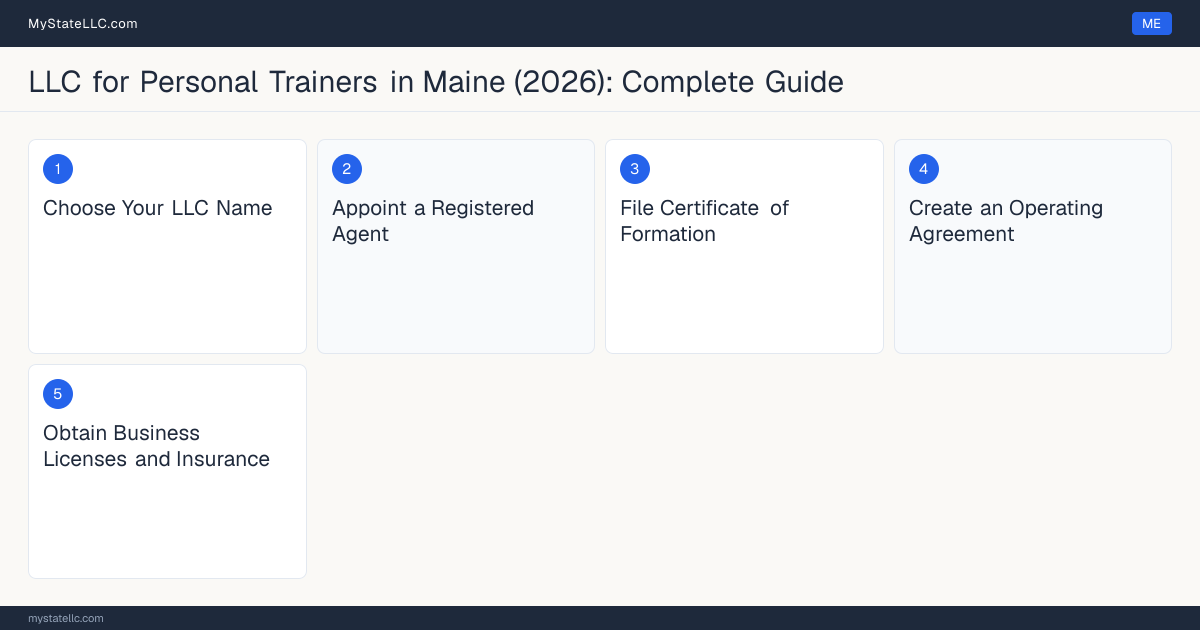
- 1
Choose Your LLC Name
Pick a memorable name ending with 'LLC' that reflects your training specialty. Consider names that work well for both in-person and online training since many Maine trainers offer virtual services during winter months.
- 2
Appoint a Registered Agent
Designate someone with a Maine address to receive legal documents. This is essential if you train clients at multiple locations or travel frequently between Portland, Bangor, and other Maine cities.
- 3
File Certificate of Formation
Submit your formation documents to the Maine Secretary of State with the $175 filing fee. Processing typically takes 5 business days, allowing you to start training clients professionally soon after.
- 4
Create an Operating Agreement
Draft an operating agreement outlining business structure, even for single-member LLCs. Include provisions for adding future trainers or expanding into group fitness programs.
- 5
Obtain Business Licenses and Insurance
Get any required local business licenses in your Maine city and secure professional liability insurance specifically designed for fitness professionals to complement your LLC protection.
Tax Considerations
Self Employment Tax
As a Maine LLC personal trainer, you'll pay self-employment tax on your net earnings, but you can deduct half of this tax as a business expense, reducing your overall tax burden compared to sole proprietorship.
Deductions
Personal trainers can deduct fitness equipment purchases, certification renewals (ACE, NASM, etc.), continuing education courses, professional liability insurance, gym membership fees for client training, fitness apps and software subscriptions, and mileage for traveling between client locations throughout Maine.
State Taxes
Maine has a graduated individual income tax (up to 7.15%) on LLC pass-through income. Maine LLCs file an annual report with the Secretary of State ($85/year, due on June 1st). There's no franchise tax on LLCs. Maine's annual report fee is moderate, and the state has a simple LLC filing process.
Do Personal Trainers Need a License in Maine?
Maine doesn't require a state license for personal trainers. A standard LLC registered with the Maine Secretary of State is sufficient, with no professional entity licensing requirements for this profession.
Do you need business insurance?
An LLC’s liability shield protects your personal assets from the business’s debts and lawsuits, but it does not protect the business itself, client injuries, property damage, and lawsuits against the company can still put its income and assets at risk.
Business insurance providers for personal trainers
Typical cost for personal trainers: general liability $29/mo median · professional liability $42/mo · limits $1M per occurrence / $2M aggregate (GL); $1M per occurrence / $1M aggregate (professional liability/malpractice), as of September 2026, per Insureon - Personal Trainer Insurance Cost. These are industry-wide medians, not quotes from the providers below. No figure in this paragraph describes a policy offered by any provider below, and the limits shown are the basis of that median rather than terms offered by any of them.
Disclosure: NEXT Insurance (ERGO NEXT), Hiscox and Thimble pay us when you request a quote through our link, whether or not you buy a policy. Embroker does not pay us. This does not affect our editorial comparisons, and coverage details always come from the insurer's own documents.
| Provider | Stated focus | AM Best rating | Insurer’s site |
|---|---|---|---|
| NEXT Insurance (ERGO NEXT) | online small business insurance for the self-employed, freelancers, contractors, sole proprietors, and micro-businesses across 1,300+ professions | A+ | Visit NEXT Insurance (ERGO NEXT) |
| Hiscox | small-business and professional liability (errors & omissions) coverage for professional-services freelancers, consultants, and specialty professions across 180+ occupations | A | Visit Hiscox |
| Embroker | digital commercial insurance (D&O, cyber, tech E&O, EPLI, professional liability) for venture-funded startups, tech companies, law firms, VC/PE firms, and other professional-services businesses | N/A | Visit Embroker |
| Thimble | on-demand, short-term (hourly/daily/monthly) general liability and professional liability insurance for freelancers, gig workers, and small businesses across 129+ industries | N/A | Visit Thimble |
Stated focus reproduces how each insurer describes its own business on its own website. It is not our recommendation, and we do not rank these providers.
IncACA is not an insurance agency, producer, or broker, and is not licensed in any state. We do not sell, solicit, or negotiate insurance, we take no applications, and we do not quote, bind, or place coverage. Every quote is requested on the insurer’s own website. This guide is general information, not insurance, legal, or financial advice. Coverage needs, requirements, and pricing vary by business, location, and carrier underwriting. Confirm policy details directly with a licensed insurance carrier or agent before making a purchasing decision.
This guide is general information, not legal or tax advice, and reading it does not create an attorney-client relationship. Read the asset-protection claims on this page narrowly. An LLC separates the company’s own obligations from what you own personally, so a trade creditor, a commercial lease, a business loan without a personal guarantee, or a judgment against the company normally reaches the company rather than your home or savings. It does not put a wall around what you personally do: you remain personally answerable for your own negligent or wrongful acts, and forming an LLC does not shield you from a claim arising from work you did yourself. Liability insurance is what answers a claim like that, not the entity. You are also personally exposed on anything you sign a personal guarantee for, and on the payroll and sales taxes most states collect from responsible individuals. Whether the shield holds at all turns on facts this page cannot see, including how the company was capitalised, whether its money is kept separate from yours, and what your state’s courts have done with veil-piercing claims. Confirm your own position with an attorney licensed in your state, and your cover with a licensed insurance agent, before you rely on anything here.
Frequently Asked Questions
Ready to Form Your Maine LLC?
Affiliate disclosure: We may earn a commission at no extra cost to you.
Start your LLC with ZenBusiness$0 service fee plus your state's filing fee. Registered agent is extra: $99 for the first year when you form with them, then $199/yr.Form your LLC with Northwest ($39 + state fee)Includes a year of registered agent service. That enrolls you by default in annual report filing at $100 plus state fees, charged automatically to your saved payment method and cancellable any time.Not sure which service is right? Compare formation services →