Protect your Michigan LLC with a properly drafted operating agreement. Get our free template and learn the state-specific requirements.
Last updated: June 2026
Michigan does not legally require an LLC operating agreement, but having one protects your limited liability status and sets the rules for ownership and profits. See exactly what to include below.
Affiliate disclosure: We may earn a commission at no extra cost to you.
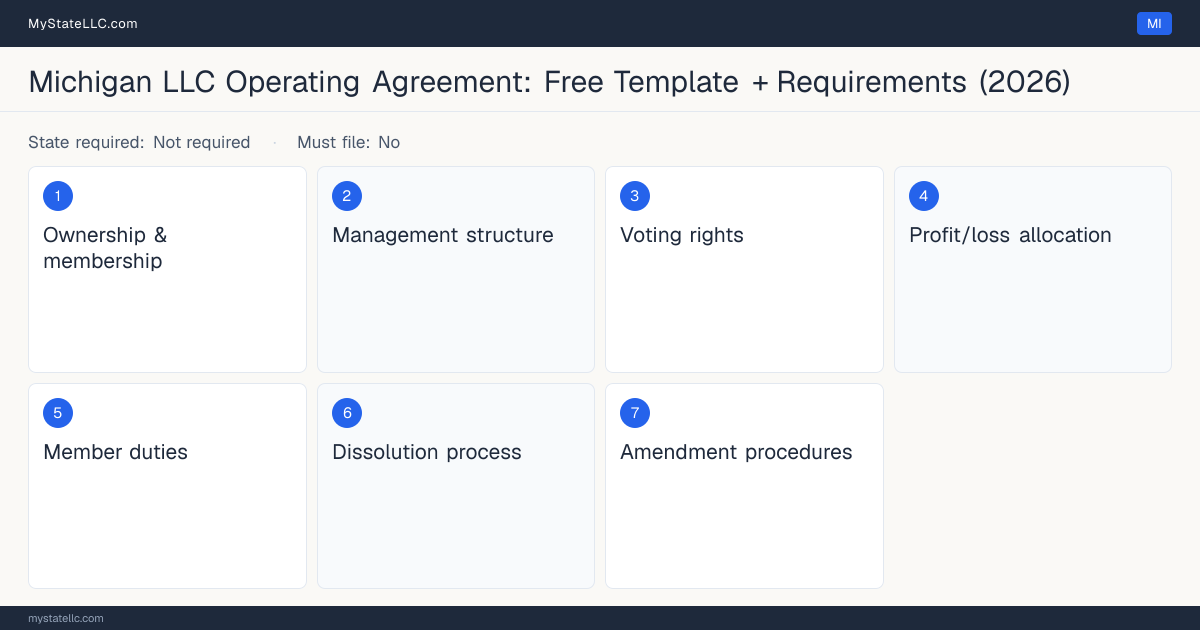
What a Michigan operating agreement should contain, section by section. Source: Michigan Department of Licensing and Regulatory Affairs, Corporations Division.
State Requirements
Required By Law
no
Must Be Filed
no
Special Rules
None beyond standard requirements
What to Include in Your Operating Agreement
Ownership & membership
Define each member's ownership percentage, capital contributions, and membership interests. This section establishes who owns what portion of your Michigan LLC and prevents future disputes.
Management structure
Specify whether your LLC is member-managed or manager-managed and outline decision-making authority. Clear management roles protect your business and ensure smooth operations.
Voting rights
Establish voting procedures, quorum requirements, and what decisions require member approval. Well-defined voting rights prevent deadlocks and ensure important decisions can be made efficiently.
Profit/loss allocation
Detail how profits and losses will be distributed among members, which may differ from ownership percentages. This section affects your tax obligations and member relationships.
Member duties
Outline each member's responsibilities, time commitments, and fiduciary duties to the LLC. Clear expectations prevent conflicts and ensure all members contribute appropriately.
Dissolution process
Define the circumstances that trigger dissolution and the process for winding up the LLC's affairs. Having a clear exit strategy protects all members' interests when the business ends.
Amendment procedures
Establish how and when the operating agreement can be modified, including voting requirements for changes. This flexibility allows your agreement to evolve with your business needs.
Frequently Asked Questions
No, Michigan doesn't legally require LLCs to have an operating agreement. However, it's highly recommended because it protects your liability shield, prevents disputes among members, and allows you to customize how your LLC operates instead of relying on default state laws.
Without an operating agreement, Michigan's Michigan Limited Liability Company Act (MCL 450.4101 et seq.) automatically applies default rules that may not align with your business intentions. For instance, if you've multiple members, state law defaults to equal profit-sharing and equal management rights, even if you contributed unequal capital. This could create costly disputes. Additionally, courts may question whether your LLC truly maintains separate legal status from its owners if you can't demonstrate formal member agreements, potentially piercing your liability shield during litigation. An operating agreement documented with the Michigan Department of Licensing and Regulatory Affairs (LARA) provides critical evidence of your LLC's legitimacy and member intentions.
Your next step: Draft a Michigan LLC operating agreement addressing profit distribution, management structure, and buyout provisions before admitting additional members or making major capital contributions.
Yes, you can draft your own Michigan LLC operating agreement, and Michigan law doesn't require a written agreement, though having one is critical for protecting your liability protection. Michigan's Limited Liability Company Act (MCL 450.4101 et seq.) allows complete flexibility in operating agreement terms, meaning you've full control over profit distribution, management structure, and member responsibilities without state-mandated provisions.
However, the practical implication matters: without a written agreement, Michigan courts will apply default state rules, which may not reflect your intentions and could expose you to personal liability claims. For single-member LLCs handling straightforward operations, drafting your own agreement using Michigan-specific templates is manageable. For multi-member LLCs, buy-sell provisions, or complex profit-sharing arrangements, an attorney consultation costs $300 to $800 and prevents costly disputes later.
Your next step: download a Michigan-specific template that includes member voting rights, capital contribution requirements, and dissolution procedures, then have an attorney review it before your members sign. This hybrid approach balances cost and protection.
No, Michigan doesn't require LLC operating agreements to be notarized. Under Michigan's Limited Liability Company Act (MCL 450.4501 et seq.), your operating agreement becomes legally effective the moment all members sign it. Notarization is entirely optional.
However, notarization carries practical benefits for LLC owners. A notarized agreement provides stronger evidence of authenticity if disputes arise or if third parties (banks, investors, or courts) question the document's validity. Many Michigan LLCs choose to notarize anyway for approximately $10 to $25 per signature through a Michigan-licensed notary public, available at banks, law offices, and UPS stores statewide.
If you plan to secure business loans, open a commercial bank account, or anticipate member disputes, notarization strengthens your position without legal requirement. The Michigan Department of Licensing and Regulatory Affairs (LARA) doesn't track or require notarized agreements during LLC formation.
To proceed, have all members sign your operating agreement simultaneously, then decide whether to visit a notary public for authentication before storing the original document with your LLC records.
Without an operating agreement, your Michigan LLC will be governed entirely by the Michigan Limited Liability Company Act (MCL 450.4101 et seq.), which imposes standardized default rules that may not reflect your business intentions. This means the state legislature, not you, determines critical decisions like profit distribution, management authority, member voting rights, and what happens if a member leaves or dies. Practically, this removes your ability to customize ownership percentages beyond equal splits, establish clear decision-making protocols, or protect minority members from majority overreach. You'll also lack written documentation of member agreements, making dispute resolution significantly more expensive and unpredictable if conflicts arise. The Michigan Department of Licensing and Regulatory Affairs (LARA) provides no operating agreement template, leaving you unprotected against the Act's rigid provisions. To regain control, draft and execute a written operating agreement signed by all members, then maintain it with your Articles of Organization filed with Michigan LARA. This single document prevents costly litigation and ensures your LLC operates exactly as you intended.
Yes, you can amend your Michigan LLC operating agreement after it's signed, but the process depends on your original agreement's terms. If your agreement specifies an amendment procedure, such as requiring a majority or unanimous member vote. You must follow that exact process. If no amendment procedure is outlined, Michigan law requires unanimous written consent from all members to make changes. This means even one dissenting member can block amendments without proper procedures in place. Practically, this creates significant operational friction: you can't unilaterally modify profit distributions, management rights, or member responsibilities without documented approval. The Michigan Department of Licensing and Regulatory Affairs (LARA) doesn't require amendment filings for operating agreements, only for Articles of Organization changes. To proceed, first review your original operating agreement for any stated amendment requirements, then obtain written consent from the required members, and maintain signed amendment documentation in your LLC records for at least seven years. Document the amendment date and have all approving members sign the amendment separately from the original agreement.
Sources
Each entry below is a document recorded in our verified Michigan sources, and each entry says what the document is. Some statutory text is read from an accurate mirror rather than from the state's own host, and those say so.
See how Northwest Registered Agent, Bizee, ZenBusiness and LegalZoom, the formation services we partner with, compare on 3-year cost, BBB rating and Trustpilot score before you choose.