New Hampshire LLC vs Sole Proprietorship: Complete 2026 Comparison
Discover the key differences between forming an LLC and staying a sole proprietor in New Hampshire, including costs, taxes, and liability protection.
Last updated: September 2026
Affiliate disclosure: We may earn a commission at no extra cost to you.
Start your LLC with ZenBusiness$0 service fee plus your state's filing fee. Registered agent is extra: $99 for the first year when you form with them, then $199/yr.Form your LLC with Northwest ($39 + state fee)Includes a year of registered agent service. That enrolls you by default in annual report filing at $100 plus state fees, charged automatically to your saved payment method and cancellable any time.Not sure which service is right? Compare formation services →
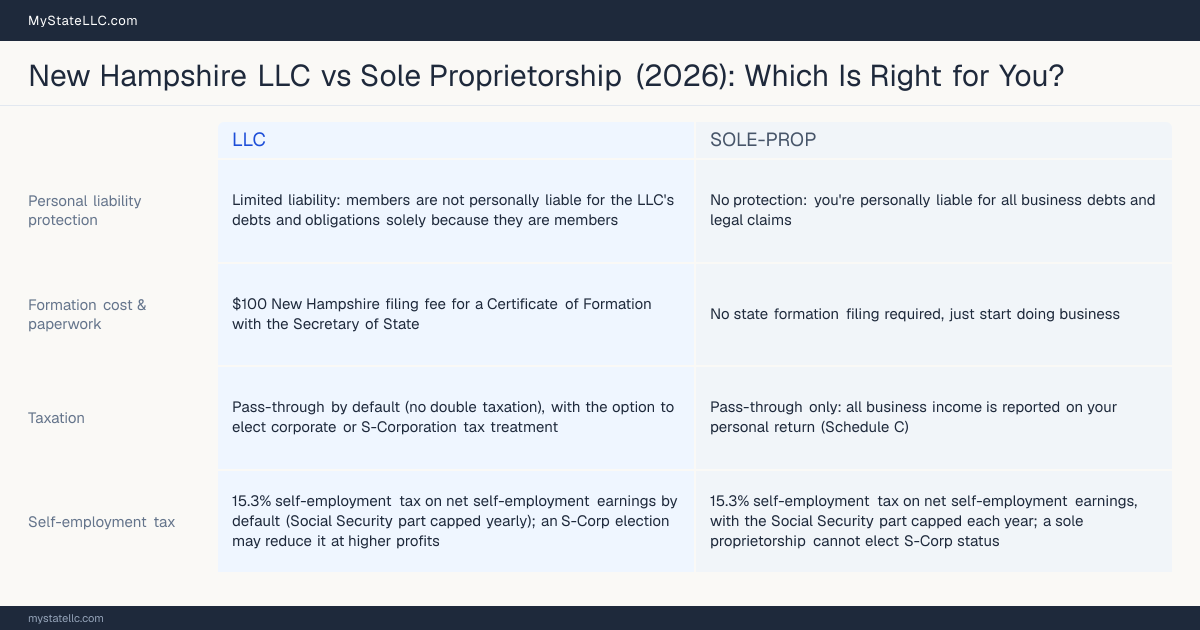
LLC vs Sole Proprietorship: Side-by-Side
| Factor | LLC | Sole Proprietorship |
|---|---|---|
| Personal liability protection | Limited liability: members are not personally liable for the LLC's debts and obligations solely because they are members | No protection: you're personally liable for all business debts and legal claims |
| Formation cost & paperwork | $100 New Hampshire filing fee for a Certificate of Formation with the Secretary of State | No state formation filing required, just start doing business |
| Taxation | Pass-through by default (no double taxation), with the option to elect corporate or S-Corporation tax treatment | Pass-through only: all business income is reported on your personal return (Schedule C) |
| Self-employment tax | 15.3% self-employment tax on net self-employment earnings by default (Social Security part capped yearly); an S-Corp election may reduce it at higher profits | 15.3% self-employment tax on net self-employment earnings, with the Social Security part capped each year; a sole proprietorship cannot elect S-Corp status |
| Business credibility | Professional appearance with 'LLC' designation helps with customers, vendors, and lenders | May appear less established: operates under your personal name or a trade name |
| Banking & contracts | Separate business bank account recommended to keep LLC and personal funds apart; easier to get business credit cards and loans | Can use personal accounts, though a separate account makes business records and taxes easier to track |
| State fees in New Hampshire | $100 to form, then a $100 annual report due by April 1 each year ($150 if late) | $0 in state formation fees; a trade name registration is required if you do business under a name other than your own |
| Conversion path to LLC | Already an LLC: can elect different tax treatments as the business grows | You can form a New Hampshire LLC later by filing a Certificate of Formation with the Secretary of State |
When an LLC Makes More Sense
- You have personal assets to protect from business liabilities
- Your profits are high enough that an S-Corp election's federal self-employment tax savings would outweigh the added payroll and accounting costs
- You want to build business credit separate from your personal credit
- You plan to have business partners or investors in the future
When a Sole Proprietorship Makes More Sense
- You're testing a business idea with minimal startup costs
- Your business has low liability risk
- You want to avoid the $100 filing fee and the $100 annual report
- Your income is modest and you want maximum tax simplicity
Tax Deep Dive
Sole Prop Tax
Sole proprietorships report business income on Schedule C of your personal federal return. You pay regular income tax plus 15.3% self-employment tax on net self-employment earnings, with the 12.4% Social Security part applying only up to an annual earnings cap, and a sole proprietorship cannot elect S-Corporation tax treatment. New Hampshire does not tax wages, and its Interest and Dividends Tax was repealed for taxable periods beginning after December 31, 2024. But New Hampshire's Business Profits Tax is not limited to corporations: RSA 77-A:1 defines a taxable business organization to include a proprietorship, so a sole proprietorship with gross business income above the filing threshold ($109,000 for taxable periods beginning on or after January 1, 2025) is subject to the 7.5% tax on its taxable business profits too.
Llc Default Tax
By default, a single-member LLC is a 'disregarded entity' for federal tax purposes, taxed like a sole proprietorship, and a multi-member LLC is taxed as a partnership. Either way, you generally still owe self-employment tax on net self-employment earnings, but an LLC can elect a different tax treatment as your business grows. New Hampshire taxes an LLC at the entity level whatever its federal classification: an LLC with gross business income above $109,000 owes the 7.5% Business Profits Tax, and one with gross receipts or an enterprise value tax base above $298,000 owes the 0.55% Business Enterprise Tax.
Llc S Corp Election
New Hampshire LLCs can elect S-Corporation tax status with the IRS to split income into a reasonable salary (subject to Social Security and Medicare payroll taxes) and distributions (not subject to those taxes). An S election does not change the New Hampshire picture: New Hampshire taxes an S corporation itself under the Business Profits Tax and Business Enterprise Tax. Whether it saves money depends on your profits and the added payroll and accounting costs, so have a CPA model it before electing.
This guide is general information, not legal or tax advice, and reading it does not create an attorney-client relationship. It reports published tax rates and statutory attributes, with the sources this page cites. It cannot tell you which structure is better for you: that turns on your profit, the salary you could defend as reasonable compensation, every state you owe tax in, and plans for owners, investors and exit that no figure on this page measures. Confirm your own position with a CPA or tax attorney licensed in your state before you elect anything, because some elections are slow or costly to reverse.
Frequently Asked Questions
Sources
Each entry below is a document recorded in our verified New Hampshire sources, and each entry says what the document is. Some statutory text is read from an accurate mirror rather than from the state's own host, and those say so.
- sos.nh.gov/corporations-0New Hampshire Secretary of State: business entity filings
- gc.nh.gov/rsa/html/XXVIII/304-C/304-C-191.htmNew Hampshire LLC filing fees
Formation Services Compared
Forming an LLC in New Hampshire?
See how Northwest Registered Agent, Bizee, ZenBusiness and LegalZoom, the formation services we partner with, compare on 3-year cost, BBB rating and Trustpilot score before you choose.
Ready to Form Your New Hampshire LLC?
Affiliate disclosure: We may earn a commission at no extra cost to you.
Start your LLC with ZenBusiness$0 service fee plus your state's filing fee. Registered agent is extra: $99 for the first year when you form with them, then $199/yr.Form your LLC with Northwest ($39 + state fee)Includes a year of registered agent service. That enrolls you by default in annual report filing at $100 plus state fees, charged automatically to your saved payment method and cancellable any time.Not sure which service is right? Compare formation services →