Texas LLC Annual Report: What to File and When (Franchise Tax)
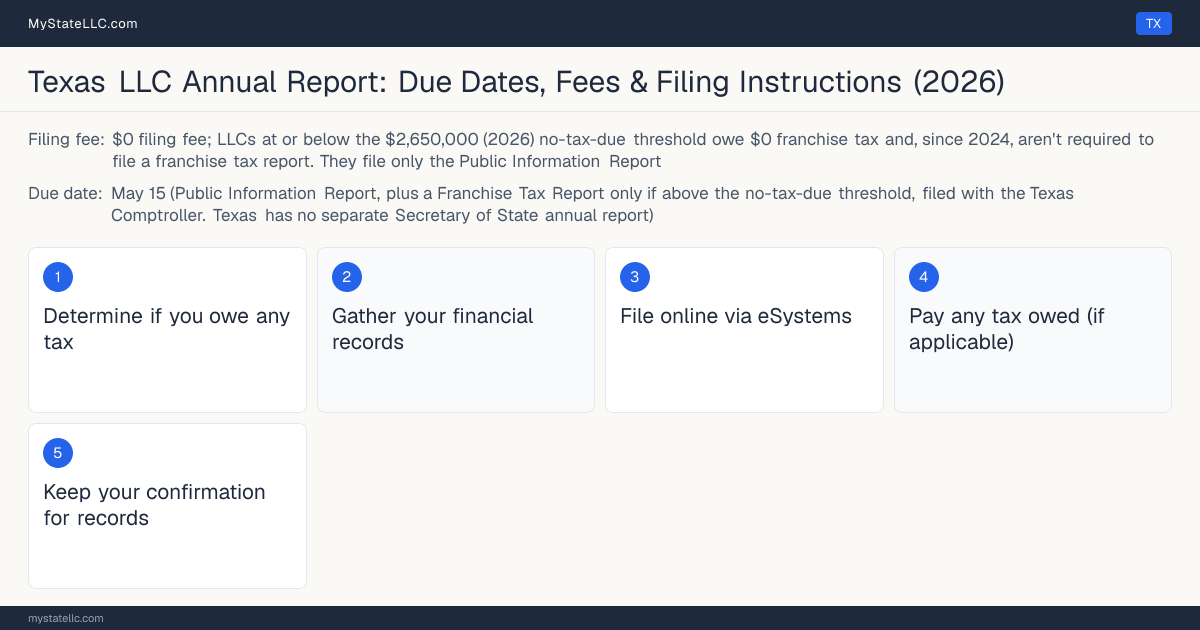
Texas LLCs file with the Comptroller, not the Secretary of State. Most owe $0 in franchise tax. At or below the $2.65M no-tax-due threshold an LLC files only the Public Information Report by May 15, because since 2024 it is not required to file a franchise tax report at all. Above the threshold, you file the Franchise Tax Report too.
Last updated: August 2026
Texas LLC annual reports are due May 15 (Public Information Report, plus a Franchise Tax Report only if above the no-tax-due threshold, filed with the Texas Comptroller. Texas has no separate Secretary of State annual report) and cost $0 to file. See details below.
Filing the Texas annual report, with the state's own fee and deadline. Source: Texas Secretary of State.
Annual Report at a Glance
Due Date
May 15 (Public Information Report, plus a Franchise Tax Report only if above the no-tax-due threshold, filed with the Texas Comptroller. Texas has no separate Secretary of State annual report)
Fee
$0
Filing Method
Online via the Texas Comptroller's eSystems portal (preferred) or by mail
Late Penalty
No $50 penalty for a late Public Information Report (typical small LLCs); the $50 late penalty applies to franchise tax reports, required only above the $2.65M threshold. The $50 franchise-tax-report penalty applies even when $0 tax is due; if franchise tax IS owed, add 5% (1 to 30 days late), 10% (more than 30 days late), plus interest
Filing Portal Url
https://www.sos.state.tx.us/corp/index.shtml
How to File
1
Determine if you owe any tax
Log into the Texas Comptroller's eSystems portal (comptroller.texas.gov). LLCs with annualized total revenue at or below the no-tax-due threshold ($2,650,000 for 2026) owe $0 franchise tax and, since 2024, aren't required to file a franchise tax report. They must still file the Public Information Report by May 15. If you exceed the threshold, you'll file the Franchise Tax Report and calculate your margin tax. Verify the current threshold with the Comptroller before filing.
2
Gather your financial records
You'll need your LLC's total revenue for its accounting year to confirm which side of the threshold you're on. Below the threshold you file only the Public Information Report. For taxable LLCs above the threshold, you'll also need cost of goods sold, compensation figures, or the 70% of revenue option, whichever gives you the lowest taxable margin, to complete the Franchise Tax Report.
3
File online via eSystems
Visit comptroller.texas.gov and log into eSystems. Select 'Franchise Tax' and follow the prompts. A below-threshold LLC's Public Information Report takes about 5 minutes. You'll receive a confirmation number when complete.
4
Pay any tax owed (if applicable)
If your LLC owes franchise tax, pay online via eSystems using an ACH bank transfer or credit card. The due date is May 15. Extensions to August 15 are available but you must file the extension request on or before May 15.
5
Keep your confirmation for records
Save or print your submission confirmation. Texas doesn't send paper acknowledgments. Your filing history is accessible in eSystems if you need proof of compliance for a bank loan or contract.
Ready to file your annual report?
Go directly to the Texas Secretary of State portal.
This guide is general information, not legal or tax advice, and reading it does not create an attorney-client relationship. It reports what each state publishes about filing deadlines, fees, and the consequences of missing them, with the sources this page cites. It cannot tell you what your own company owes: the date turns on when and where you formed, states change these rules between our reviews, and in several states an entity-level tax falls due in a year when no report does. Confirm your own dates with the filing office named on this page before you rely on one here, because the penalty for missing a deadline can be administrative dissolution of the company.
Frequently Asked Questions
First, know which filing you owe. If your LLC is at or below the $2,650,000 (2026) no-tax-due threshold, you file only a Public Information Report, and Texas doesn't charge the $50 late-filing penalty on a late PIR. The $50 penalty applies to a late franchise tax report (even when no tax is owed), and below-threshold LLCs haven't been required to file one since 2024. So a typical small LLC that files its PIR late doesn't owe the $50 penalty.
The bigger risk is non-monetary. Keep skipping the filing and ignore the Comptroller's notices, and the Comptroller forfeits your LLC's corporate privileges, then notifies the Texas Secretary of State, which forfeits the entity's right to transact business in Texas. That shows up on the public record, and Texas law can make the people running the business personally liable for certain debts incurred after the forfeiture.
Reinstatement with the Secretary of State costs $75 either way: Form 801 to set aside a tax forfeiture, or Form 811 after an involuntary termination or revocation. The Comptroller has to issue a tax clearance letter first, which means filing every past-due report and paying any back franchise tax, the $50-per-report penalty on any late franchise tax reports (above-threshold LLCs only), and interest.
The Public Information Report (and a Franchise Tax Report if you're above the threshold) is due annually by May 15. Contact the Texas Comptroller of Public Accounts if you've missed a deadline, and verify current thresholds and penalties with the Comptroller.
File online through the Texas Comptroller's eSystems portal at comptroller.texas.gov using your 11-digit Texas taxpayer number assigned at formation. The annual deadline is May 15th each year.
Most Texas LLCs have annualized revenue at or below the no-tax-due threshold ($2,650,000 for 2026), so they owe $0 franchise tax and, since 2024, aren't required to file a franchise tax report. They file only the Public Information Report (PIR) by May 15. Texas doesn't charge the $50 late-filing penalty on a late PIR, but you should still file on time to stay in good standing. Being under the threshold doesn't excuse you from filing the PIR.
If your LLC exceeds the threshold, you must calculate your margin tax and file the full Franchise Tax Report along with the PIR; a franchise tax report filed after May 15 triggers the $50 late-filing penalty even if no tax is owed. This filing requires accounting records and often costs several hundred dollars in professional preparation if outsourced.
Log into the eSystems portal using your taxpayer number to determine which forms apply to your revenue level, then file before May 15th. Verify the current threshold with the Comptroller before filing.
Texas LLCs owe $0 in franchise tax if annualized total revenue stays at or below $2,650,000, the no-tax-due threshold for 2026 reports. Above that limit the Comptroller taxes your taxable margin at one of two rates: 0.375% for entities primarily engaged in retail or wholesale trade, and 0.75% for everyone else. There is no sliding scale between them. Because the tax is computed on margin rather than gross receipts, the effective cost is usually well under 1% of revenue, which is why Texas still compares favorably with income-tax states. LLCs at or below the threshold still file the Public Information Report by May 15, but Texas doesn't charge the $50 late-filing penalty on a late PIR, and since 2024 those LLCs aren't required to file a franchise tax report at all. The $50 penalty attaches to a late franchise tax report, which is required only above the threshold, and it applies even when $0 tax is due. If tax is actually owed, add 5% for 1 to 30 days late, 10% beyond that, plus interest. File through the Comptroller's portal at comptroller.texas.gov, and verify the current threshold and penalty rules with the Comptroller before you file.
The Texas franchise tax report and the Public Information Report are both due May 15 each year, filed with the Texas Comptroller of Public Accounts. The Comptroller adds that if May 15 falls on a weekend or holiday, the due date will be the next business day. If you cannot make the deadline, file an extension request with the Comptroller on or before May 15; extensions run to August 15 for most filers. The discontinued No Tax Due Report is no longer an option, since LLCs at or below the $2,650,000 no-tax-due threshold have not been required to file a franchise tax report since the 2024 report year and file only the Public Information Report. Missing May 15 without an extension exposes an above-threshold LLC to the $50 late-report penalty plus percentage penalties and interest on any tax owed, while a below-threshold LLC that files its PIR late does not owe the $50 penalty. Either way, continued non-filing leads to forfeiture of the right to transact business in Texas, so file through the Comptroller's eSystems portal at comptroller.texas.gov and keep the confirmation.
Small size is not an exemption. An LLC with annualized total revenue at or below the $2,650,000 no-tax-due threshold for 2026 owes $0 franchise tax, but the Comptroller is explicit that being under the threshold does not excuse filing: you still file the Public Information Report by May 15. Since the 2024 report year those LLCs are not required to file the franchise tax report itself.
Genuine exemptions are narrow and statutory rather than size-based. Certain nonprofit and other qualifying organizations can be exempt from franchise tax, and an exemption has to be claimed and supported with the Comptroller rather than assumed. Note that the passive entity provisions people often reach for do not fit a typical operating LLC, so do not treat passive income alone as a reason to stop filing.
The cost of getting this wrong is real: back tax, interest, and the $50-per-report penalty on any franchise tax report you should have filed, plus eventual forfeiture of your right to transact business in Texas. Undoing that forfeiture takes a Comptroller tax clearance letter and a $75 reinstatement filing with the Secretary of State, Form 801 for a tax forfeiture or Form 811 after an involuntary termination or revocation. Verify your specific exemption eligibility with the Texas Comptroller or a Texas CPA before you rely on it.
Sources
Each entry below is a document recorded in our verified Texas sources, and each entry says what the document is. Some statutory text is read from an accurate mirror rather than from the state's own host, and those say so.
See how Northwest Registered Agent, Bizee, ZenBusiness and LegalZoom, the formation services we partner with, compare on 3-year cost, BBB rating and Trustpilot score before you choose.