Protect your Utah LLC with a comprehensive operating agreement. Learn the requirements and get expert templates for single and multi-member LLCs.
Last updated: September 2026
Utah does not legally require an LLC operating agreement, but having one protects your limited liability status and sets the rules for ownership and profits. See exactly what to include below.
Affiliate disclosure: We may earn a commission at no extra cost to you.
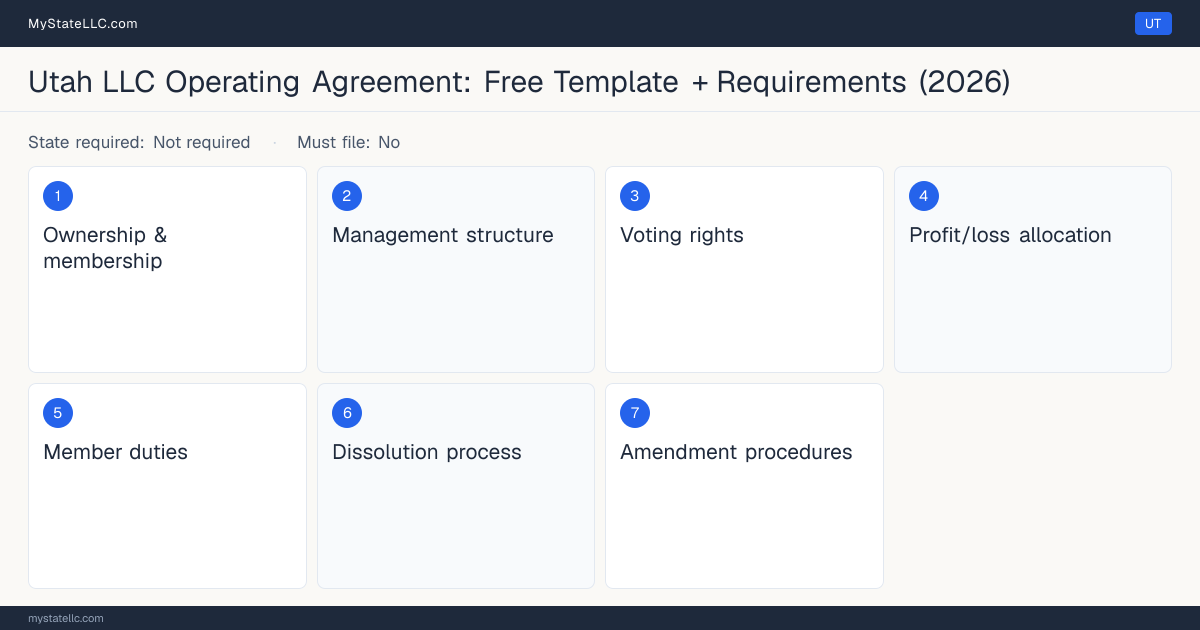
What a Utah operating agreement should contain, section by section. Source: Utah Division of Corporations and Commercial Code.
State Requirements
Required By Law
No
Must Be Filed
No
Special Rules
Utah follows the Revised Uniform Limited Liability Company Act. While not required by law, an operating agreement is strongly recommended to override default state rules and provide clarity on LLC operations.
What to Include in Your Operating Agreement
Ownership & membership
Define each member's ownership percentage, capital contributions, and membership interests. This section establishes who owns what portion of your Utah LLC and their financial stake.
Management structure
Specify whether your LLC is member-managed or manager-managed, and outline the roles and responsibilities of managers or managing members. Utah law allows flexibility in management structure.
Voting rights
Establish voting procedures for major decisions, including what constitutes a quorum and what percentage of votes is needed for different types of decisions affecting the LLC.
Profit/loss allocation
Detail how profits and losses will be distributed among members, which may differ from ownership percentages. This affects both tax reporting and member compensation.
Member duties
Outline the responsibilities, obligations, and restrictions for LLC members, including any non-compete clauses or duties of loyalty specific to your Utah business.
Dissolution process
Define the circumstances that trigger LLC dissolution and the procedures for winding up the business, distributing assets, and handling final obligations under Utah law.
Amendment procedures
Establish how the operating agreement can be modified in the future, including required approvals and documentation procedures to ensure changes are properly executed.
Frequently Asked Questions
No, Utah doesn't legally require LLCs to have a written operating agreement under the Utah Revised Limited Liability Company Act (ULLCA). However, this creates significant practical risks for LLC owners. Without a formal operating agreement, your LLC automatically defaults to Utah's statutory provisions, which assume equal ownership stakes and equal management rights regardless of actual capital contributions or work performed. This means if you've multiple members, disputes over profits, decision-making authority, or member withdrawal procedures will be resolved according to state law rather than your intentions. For single-member LLCs, the lack of an agreement weakens liability protection and complicates succession planning. The Utah Division of Corporations and Commercial Code doesn't require operating agreements for registration, and the Utah Division of Corporations and Commercial Code doesn't mandate filing one with your Certificate of Organization. However, lenders, investors, and business partners typically request operating agreements before committing resources. Creating a custom operating agreement now protects your ownership structure and prevents costly litigation later. Draft or customize your operating agreement before admitting additional members or making significant capital commitments.
Yes, you can draft your own Utah LLC operating agreement without legal assistance. The Utah Revised Uniform Limited Liability Company Act (Utah Code § 48-3a-101 et seq.) doesn't mandate a written operating agreement, giving you complete freedom to create one yourself. However, your agreement must address Utah-specific requirements: member voting rights, profit distribution percentages, dissolution procedures, and management structure (member-managed or manager-managed). Missing critical provisions exposes you to Utah's default LLC rules, which may conflict with your intended business structure. For example, Utah law defaults to equal profit sharing regardless of capital contributions unless your agreement specifies otherwise. Using a professional template or consulting an attorney costs $500 to $1,500 but prevents costly disputes later. If you proceed independently, file your Certificate of Organization with the Utah Division of Corporations and Commercial Code first, then finalize your operating agreement before conducting business. Review your draft against Utah's LLC statutes to catch compliance gaps before they create legal problems.
No, Utah doesn't require LLC operating agreements to be notarized under the Utah Revised Uniform Limited Liability Company Act. However, all members must sign the agreement, and notarization is strongly recommended for practical reasons. Without notarization, members could later dispute whether signatures are authentic, potentially complicating disputes over management authority or profit distribution. Notarization costs $5 to 15 per signature in Utah and creates a certified record that courts recognize as credible evidence of intent. This protection becomes especially valuable if you need to enforce operating agreement terms in court or if a member claims they didn't authorize a particular clause. You can have a notary public at any Utah bank, title company, or UTA office notarize your signatures simultaneously. This one-time investment prevents costly litigation over signature validity and strengthens your LLC's legal standing if disputes arise among members.
Without an operating agreement, your Utah LLC will be governed by the state's default LLC laws under the Utah Revised Limited Liability Company Act (URLLCA). This means the Division of Corporations and Commercial Code will impose statutory default rules that likely won't match your specific business structure.
Specifically, Utah's default provisions dictate that all members share profits equally regardless of capital contributions, management decisions require unanimous consent, and dissolution follows state-mandated procedures. If you've two members but one invested 80% of startup capital, you'd still split profits 50/50 without a written agreement, a significant financial disadvantage.
Additionally, without documented operating procedures, disputes between members often escalate to costly litigation because there's no internal dispute resolution mechanism. Lenders and investors typically won't fund an LLC without a formal operating agreement, as it signals poor governance.
Your immediate next step: Download Utah's LLC operating agreement template, customize it for your member structure and profit-sharing terms, have all members sign it, and retain a copy with your LLC records, even if you don't file it with the state.
Yes, you can amend your Utah LLC operating agreement at any time by following the procedures specified in your original agreement. If your agreement doesn't outline amendment procedures, the safe course is unanimous written consent from all members before any provision is modified. However, certain amendments. Such as changes affecting member liability or profit distributions. May require filing an amended Certificate of Formation with the Utah Division of Corporations and Commercial Code, costing $52 for expedited processing. The practical implication is that without clear amendment language in your original agreement, a single dissenting member can block changes, potentially freezing your LLC's governance. To proceed, first review your existing operating agreement's amendment section, then prepare written documentation of the proposed changes and secure signatures from all members. Submit any required filings to the Division of Corporations within 30 days of member approval to ensure your public records reflect the updated structure.
Sources
Each entry below is a document recorded in our verified Utah sources, and each entry says what the document is. Some statutory text is read from an accurate mirror rather than from the state's own host, and those say so.
See how Northwest Registered Agent, Bizee, ZenBusiness and LegalZoom, the formation services we partner with, compare on 3-year cost, BBB rating and Trustpilot score before you choose.