Anonymous LLC in Iowa (2026): How to Keep Your Name Off Public Records
Iowa requires no member or manager to be named on any routine public filing, not on the Certificate of Organization, and not on any annual or biennial report. Form directly, with no holding entity. Exact costs and steps.
Last updated: September 17, 2026
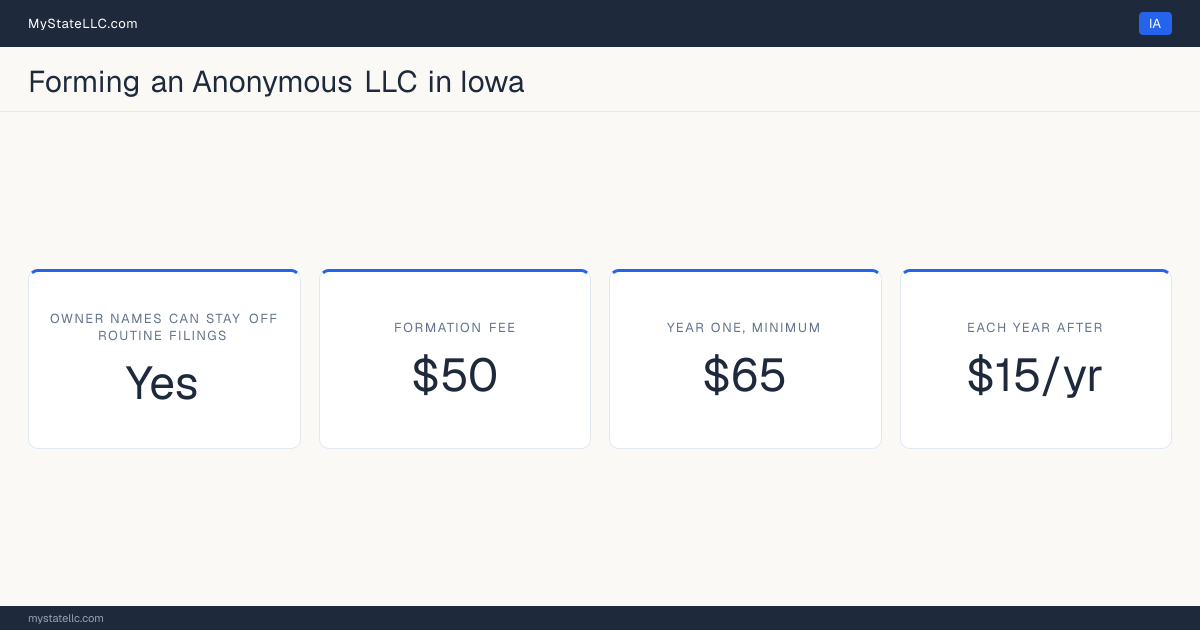
Yes, Iowa allows anonymous LLC formation. No member or manager name is required on the Certificate of Organization, and none is required on any annual or biennial report. You can form directly in Iowa with no holding entity in another state. Read the note below for the exceptions worth knowing.
Iowa requires no member or manager names on the Certificate of Organization or the biennial report; only the organizer and registered agent are public.
Public Disclosure at a Glance
Question
Answer
Is a member or manager required on any routine public filing?
✓ No
Formation document
Certificate of Organization
Recurring state report
Biennial report
Source: IncACA 50-state anonymity dataset, verified against official Secretary of State filing requirements and statutes, July 2026. Anonymity here means member and manager names can be kept off every routine public filing, at formation and on any periodic report.
How to Form an Anonymous LLC in Iowa
Because Iowa requires no member or manager to be named on the Certificate of Organization or on any periodic report, you can form an anonymous LLC directly in the state without a holding entity. Follow these steps:
1
Choose a Business Name That Doesn't Identify You
Your LLC name appears in public records even when members don't. Choose a name that doesn't include your personal name, for example, “Blue Ridge Holdings LLC” rather than “Jane Smith Consulting LLC.” Search the Iowa Secretary of State's business name database to confirm availability. A distinctive name also reduces the risk of name-based searches linking the LLC to you on social media or business directories.
2
Appoint a Professional Registered Agent
Your registered agent's address appears on public filings in place of a member address. Use a professional registered agent service, see our registered agent guide for a comparison of services. A professional RA keeps your personal address out of the registered agent field and accepts legal notices on your behalf at its own address during business hours.
3
File the Certificate of Organization
File with the Iowa Secretary of State. The filing lists the LLC name, registered agent name and address, and organizer information. The organizer can be your attorney, a registered agent service, or any individual. It does not need to be the LLC member. Filing fee: $50, plus $15 of other mandatory first-year state costs. Consider using your attorney or the registered agent service as the organizer to keep your name out of even this initial filing.
4
Obtain an EIN from the IRS
Apply for an Employer Identification Number (EIN) from the IRS. You must provide a “responsible party” name and Social Security Number. This is submitted to the IRS (not publicly disclosed) and does not appear in state business records. Use the LLC's EIN for all banking and business purposes.
5
Draft an Operating Agreement
Your operating agreement is a private document, not filed with any state agency. That establishes your ownership of the LLC. This document is critical for banking, legal protection, and tax purposes. It establishes management structure, profit distribution, member rights, and dissolution terms.
6
Open a Business Bank Account
Bring your EIN confirmation letter, Articles of Organization, and operating agreement to a bank. The banker will verify your personal ID per FinCEN beneficial ownership rules. This verification is kept in the bank's internal records, not in any public database. Maintaining a separate business bank account is essential for preserving your LLC's liability protection.
Ready to form your Iowa anonymous LLC?
Our affiliate partners Northwest Registered Agent and ZenBusiness file the formation paperwork and can serve as your registered agent, so the registered agent address on public filings is the service's address, not yours.
Northwest: $39 + state fee, including a year of registered agent service, which then renews at $125/yr. Registered agent customers are enrolled by default in biennial report filing at $100 plus state fees per report, charged automatically to your saved payment method and cancellable any time. ZenBusiness: $0 + state fee, with registered agent service sold separately at $99 for the first year when you form with them, which then renews at $199/yr.
Affiliate link. We may earn a commission at no extra cost to you. This does not affect our recommendations.
Total Cost Breakdown
Fees
Item
One-Time
Annual
Iowa LLC filing fee
$50
N/A
Other mandatory Iowa first-year state costs
$15
N/A
Registered agent
N/A
~$125/yr
Iowa recurring state cost
N/A
$15/yr
Total Year 1, incl. agent
$190
N/A
Ongoing (Year 2+), incl. agent
N/A
$140/yr
Forming directly in Iowa needs no holding entity, so there are no double registration fees. Total Year 1 includes one year of registered agent service; that fee is a commercial service price, not a state charge, and varies by provider. Every state figure comes from our 50-state cost dataset, verified against each Secretary of State’s published fee schedule in July 2026.
Frequently Asked Questions
Yes. Iowa asks for no member or manager names on either the Certificate of Organization or the Biennial Report. The names that do become public are the organizer and the registered agent, so whoever fills those two roles is who Iowa's record shows. Because the privacy comes from Iowa's own forms, this page describes forming directly in Iowa rather than through a holding LLC in another state. The Certificate of Organization costs $50.
Iowa charges $50 for the Certificate of Organization and $30 for the Biennial Report, which is filed between January 1 and April 1 of each odd-numbered year. With a registered agent included, this page estimates $190 for the first year and $140 a year after that. Our review of Iowa Code chapter 489 found no annual LLC franchise or minimum entity tax, although that finding was not separately checked against an Iowa Department of Revenue publication. Chapter 489 also imposes no newspaper publication requirement.
Yes. Anonymous LLCs are completely legal in the United States. No federal law prohibits structuring your LLC to minimize public disclosure of member names. The strategy relies on a legitimate feature of some state LLC laws: a few states require no member or manager to be named on routine public filings. Using a Wyoming or New Mexico LLC as the sole member of your operating LLC is a standard asset protection technique used by real estate investors, business owners, and privacy-conscious professionals across the country. The LLC still pays taxes, files required returns, and complies with all federal and state regulations. The difference is in what the state business registries show, and in many states they can still show who owns or manages the LLC. Note that the IRS and other federal agencies can still identify the true beneficial owner through tax filings and formal legal processes.
Yes, but you will need to provide your personal identification to the bank regardless of your LLC structure. The Bank Secrecy Act and FinCEN's Customer Due Diligence (CDD) rules require banks to collect and verify the identity of beneficial owners who own 25% or more of any entity opening an account. A requirement that applies even if your name doesn't appear in public state records. In practice, this means you'll present your EIN letter, LLC operating agreement, and your personal ID (driver's license or passport) to the bank officer. The bank holds your information internally but does not make it public. Whether your name appears in public Secretary of State databases depends on what each state's filings require, which this page describes.
An anonymous LLC provides two layers of protection: liability protection and privacy. The liability protection, keeping personal assets separate from business debts and judgments, comes from the LLC structure itself and exists whether or not your LLC is anonymous. The anonymity adds a practical privacy layer: a plaintiff's attorney doing an asset search may not find your LLC in a business registry under your name, although many states' registries still name members or managers. However, an anonymous LLC is not bulletproof against determined legal adversaries. A court-ordered subpoena can compel your registered agent, attorney, or bank to disclose your identity. Maintaining the LLC properly, separate bank accounts, signed operating agreement, no commingling of personal and business funds, is more important than anonymity for lawsuit protection.
Yes. The IRS has full visibility into LLC ownership regardless of your public anonymity structure. When your LLC obtains an Employer Identification Number (EIN), you must provide a responsible party's Social Security Number or ITIN on IRS Form SS-4. If your LLC is taxed as a partnership or S-Corp, the annual return (Form 1065 or 1120-S) lists all members or shareholders with their Social Security Numbers. Even single-member LLCs taxed as disregarded entities report LLC income on Schedule C of the owner's personal 1040. The anonymity provided by a Wyoming or New Mexico LLC is strictly about what appears in publicly searchable state business registries, not about tax reporting. There is no legal mechanism to hide LLC ownership from the IRS.
The terms overlap but have important distinctions. An anonymous LLC is a legitimately formed LLC where ownership isn't easily traceable through public state records. It's a privacy tool used by real estate investors, entrepreneurs, and privacy-conscious business owners. A shell company, in the pejorative sense, typically refers to an entity with no active business operations used to move or hide money, often associated with tax evasion or money laundering. Most anonymous LLCs are not shell companies: they operate real businesses, pay taxes, and comply with all regulations. The main legal development to understand is FinCEN's Beneficial Ownership Information (BOI) reporting rule under the Corporate Transparency Act. It once required domestic LLC owners to report their identities to FinCEN, but FinCEN's interim final rule of March 26, 2025 exempted every entity created in the United States, so US-formed LLCs currently file no BOI report at all. That rule is interim rather than final, and it does not erase reports already filed. FinCEN has published no way to withdraw one. Anonymity from public records has also never meant anonymity from the government: the IRS sees your tax filings, banks collect and verify beneficial ownership under separate customer due diligence rules, and law enforcement can compel disclosure.
Each entry below is a document recorded in our verified Iowa sources, and each entry says what the document is. Some statutory text is read from an accurate mirror rather than from the state's own host, and those say so.