Illinois LLC for Real Estate Investors: Protect Your Portfolio
Shield your assets, optimize taxes, and scale your property investments with an Illinois LLC designed for real estate professionals Year one in Illinois costs $225 in mandatory state charges, then $75 a year.
Last updated: July 2026
Formation Services Compared
Ready to form your Illinois LLC?
Compare the formation services we partner with before you pay: pricing, registered agent renewal costs and BBB ratings side by side.
Affiliate disclosure: We may earn a commission at no extra cost to you.
Start your LLC with ZenBusiness$0 service fee plus your state's filing fee. Registered agent is extra: $99 for the first year when you form with them, then $199/yr.Form your LLC with Northwest ($39 + state fee)Includes a year of registered agent service. That enrolls you by default in annual report filing at $100 plus state fees, charged automatically to your saved payment method and cancellable any time.Not sure which service is right? Compare formation services →
Yes, forming an Illinois LLC is highly recommended for real estate investors managing multiple properties or seeking asset protection.
Illinois offers strong LLC protection laws that shield your personal assets from property-related liabilities. The state's Series LLC option allows you to separate each property into its own series, providing additional protection while maintaining streamlined management and potential tax benefits.
Key Benefits of an LLC for Illinois
Asset Protection Across Properties
Illinois LLCs create a legal barrier between your personal assets and property-related liabilities, protecting your home and savings from tenant lawsuits or property damage claims.
Series LLC for Portfolio Management
Illinois allows Series LLCs, enabling you to hold each property in a separate series under one umbrella LLC, providing individual asset protection while reducing formation and maintenance costs.
Enhanced Mortgage and Financing Options
Many lenders prefer working with LLCs for investment properties, and you can often secure better commercial lending rates while building business credit separate from your personal credit.
Tax Flexibility and Deductions
Illinois LLCs offer pass-through taxation while allowing you to deduct property expenses, depreciation, and business-related costs, potentially reducing your overall tax burden significantly.
Professional Credibility and Privacy
Operating through an LLC enhances your credibility with tenants, contractors, and lenders while keeping your personal information private in property records and transactions.
How to Form Your LLC
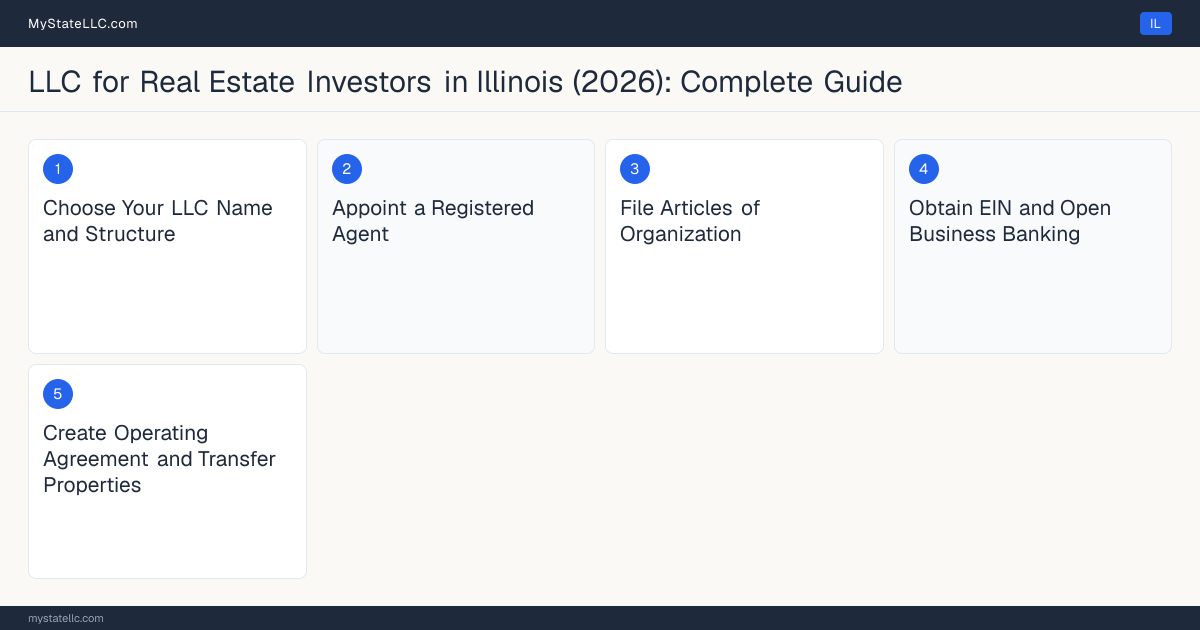
- 1
Choose Your LLC Name and Structure
Select a name ending in 'LLC' or 'Limited Liability Company' that reflects your real estate focus. Consider whether a standard LLC or Series LLC better fits your portfolio - Series LLCs work well if you plan to own multiple properties and want separate liability protection for each.
- 2
Appoint a Registered Agent
Choose a registered agent with an Illinois address to receive legal documents. For real estate investors, using a professional service maintains privacy and ensures you receive important notices even when traveling between properties.
- 3
File Articles of Organization
Submit your Articles of Organization to the Illinois Secretary of State with the $150 filing fee. Include your registered agent information and specify if you're forming a Series LLC. The Illinois Secretary of State publishes no standard processing time for this filing.
- 4
Obtain EIN and Open Business Banking
Get an Employer Identification Number from the IRS, then open a dedicated business bank account. This separation matters for maintaining your LLC's liability protection and simplifying property income and expense tracking.
- 5
Create Operating Agreement and Transfer Properties
Draft an operating agreement detailing member roles, profit distribution, and property management procedures. If you're transferring existing properties, use quitclaim deeds to move ownership to your LLC, but consult with your mortgage lender first about due-on-sale clauses.
Tax Considerations
Self Employment Tax
Real estate investors using Illinois LLCs typically avoid self-employment tax on rental income, as passive rental activities aren't subject to SE tax. However, if you're actively involved in real estate development or flipping, those activities may be subject to SE tax.
Deductions
Illinois LLC real estate investors can deduct mortgage interest, property taxes, depreciation, repairs and maintenance, property management fees, insurance premiums, travel expenses to properties, home office costs, and professional services like accounting and legal fees.
State Taxes
Illinois LLCs face an annual report fee of $75 and the personal property replacement income tax of 1.5% on net income, paid at the entity level. Illinois also has a flat 4.95% individual income tax that applies to pass-through earnings. Chicago businesses face additional city taxes. There's no franchise tax at the state level, but total tax burden for Illinois LLCs is above the national average.
Do Real Estate Investors Need a License in Illinois?
Illinois doesn't require a license to invest in real estate for one's own account. A standard LLC formed through the Illinois Secretary of State is sufficient, and no PLLC or special real estate investor license is required by the Illinois Department of Financial and Professional Regulation.
Do you need business insurance?
An LLC’s liability shield protects your personal assets from the business’s debts and lawsuits, but it does not protect the business itself, client injuries, property damage, and lawsuits against the company can still put its income and assets at risk.
Business insurance providers for real estate investors
Typical cost for real estate investors: general liability $68/mo median · professional liability $68/mo · limits $1M per occurrence / $2M aggregate (GL); $1M per occurrence / $1M aggregate (errors and omissions), as of September 2026, per Insureon - Commercial Landlord Insurance Cost. These are industry-wide medians, not quotes from the providers below. No figure in this paragraph describes a policy offered by any provider below, and the limits shown are the basis of that median rather than terms offered by any of them.
Disclosure: NEXT Insurance (ERGO NEXT), Hiscox and Thimble pay us when you request a quote through our link, whether or not you buy a policy. Embroker does not pay us. This does not affect our editorial comparisons, and coverage details always come from the insurer's own documents.
| Provider | Stated focus | AM Best rating | Insurer’s site |
|---|---|---|---|
| NEXT Insurance (ERGO NEXT) | online small business insurance for the self-employed, freelancers, contractors, sole proprietors, and micro-businesses across 1,300+ professions | A+ | Visit NEXT Insurance (ERGO NEXT) |
| Hiscox | small-business and professional liability (errors & omissions) coverage for professional-services freelancers, consultants, and specialty professions across 180+ occupations | A | Visit Hiscox |
| Embroker | digital commercial insurance (D&O, cyber, tech E&O, EPLI, professional liability) for venture-funded startups, tech companies, law firms, VC/PE firms, and other professional-services businesses | N/A | Visit Embroker |
| Thimble | on-demand, short-term (hourly/daily/monthly) general liability and professional liability insurance for freelancers, gig workers, and small businesses across 129+ industries | N/A | Visit Thimble |
Stated focus reproduces how each insurer describes its own business on its own website. It is not our recommendation, and we do not rank these providers.
IncACA is not an insurance agency, producer, or broker, and is not licensed in any state. We do not sell, solicit, or negotiate insurance, we take no applications, and we do not quote, bind, or place coverage. Every quote is requested on the insurer’s own website. This guide is general information, not insurance, legal, or financial advice. Coverage needs, requirements, and pricing vary by business, location, and carrier underwriting. Confirm policy details directly with a licensed insurance carrier or agent before making a purchasing decision.
This guide is general information, not legal or tax advice, and reading it does not create an attorney-client relationship. Read the asset-protection claims on this page narrowly. An LLC separates the company’s own obligations from what you own personally, so a trade creditor, a commercial lease, a business loan without a personal guarantee, or a judgment against the company normally reaches the company rather than your home or savings. It does not put a wall around what you personally do: you remain personally answerable for your own negligent or wrongful acts, and forming an LLC does not shield you from a claim arising from work you did yourself. Liability insurance is what answers a claim like that, not the entity. You are also personally exposed on anything you sign a personal guarantee for, and on the payroll and sales taxes most states collect from responsible individuals. Whether the shield holds at all turns on facts this page cannot see, including how the company was capitalised, whether its money is kept separate from yours, and what your state’s courts have done with veil-piercing claims. Confirm your own position with an attorney licensed in your state, and your cover with a licensed insurance agent, before you rely on anything here.
Frequently Asked Questions
Ready to Form Your Illinois LLC?
Affiliate disclosure: We may earn a commission at no extra cost to you.
Start your LLC with ZenBusiness$0 service fee plus your state's filing fee. Registered agent is extra: $99 for the first year when you form with them, then $199/yr.Form your LLC with Northwest ($39 + state fee)Includes a year of registered agent service. That enrolls you by default in annual report filing at $100 plus state fees, charged automatically to your saved payment method and cancellable any time.Not sure which service is right? Compare formation services →