Protect your Ohio LLC with a comprehensive operating agreement. Get our free template plus expert guidance on Ohio's requirements.
Last updated: September 2026
Ohio does not legally require an LLC operating agreement, but having one protects your limited liability status and sets the rules for ownership and profits. See exactly what to include below.
Affiliate disclosure: We may earn a commission at no extra cost to you.
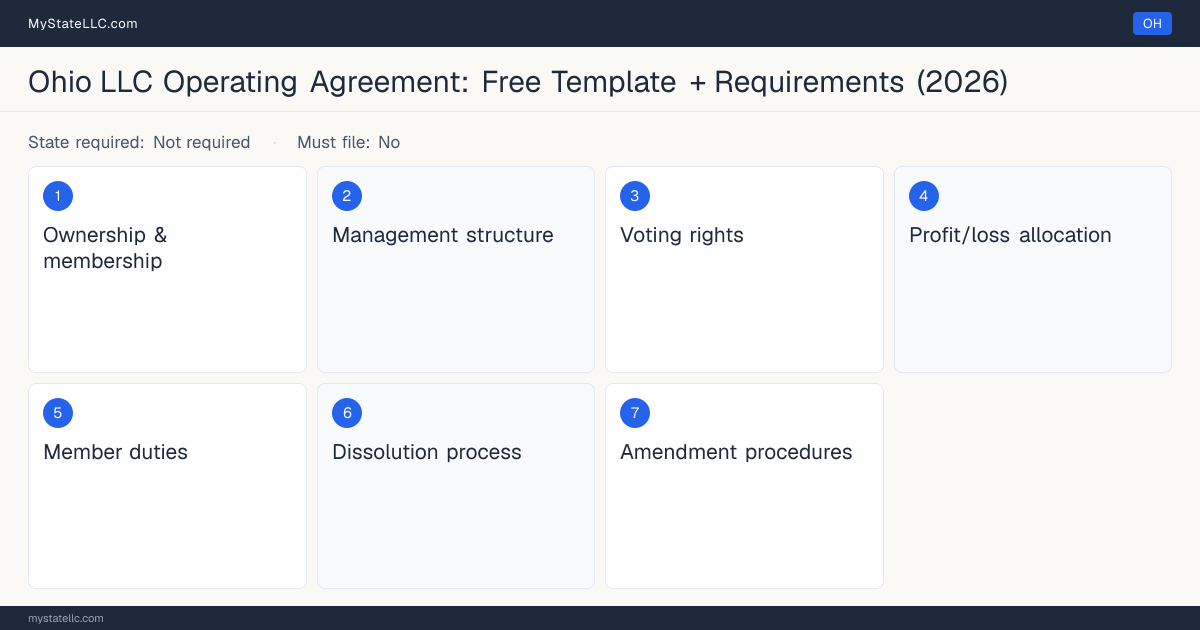
What a Ohio operating agreement should contain, section by section. Source: Ohio Secretary of State.
State Requirements
Required By Law
no
Must Be Filed
no
Special Rules
None beyond standard requirements
What to Include in Your Operating Agreement
Ownership & membership
Define each member's ownership percentage and capital contributions. This section establishes who owns what portion of your Ohio LLC and prevents future disputes.
Management structure
Specify whether your LLC is member-managed or manager-managed under Ohio law. This determines who has authority to make decisions and bind the company.
Voting rights
Outline how decisions are made and what voting power each member has. Include requirements for major decisions like admitting new members or changing business direction.
Profit/loss allocation
Detail how profits and losses are distributed among members for tax purposes. This doesn't have to match ownership percentages but must be clearly documented.
Member duties
Define each member's responsibilities, time commitments, and any restrictions on competing businesses. Clear expectations prevent conflicts and protect your Ohio LLC.
Dissolution process
Establish procedures for winding up the LLC if members decide to close it. Include asset distribution methods and member exit procedures to avoid legal complications.
Amendment procedures
Set rules for how the operating agreement can be changed in the future. Specify voting requirements and documentation needed to modify the agreement.
Frequently Asked Questions
No, Ohio law doesn't legally require LLCs to have an operating agreement. However, this absence of a mandate creates significant risk for Ohio business owners. Without a written agreement, your LLC will default to Ohio Revised Code Chapter 1706 provisions, which may not align with your intentions regarding profit distribution, management authority, or member withdrawal procedures. For single-member LLCs, the lack of documentation weakens liability protection. Courts may pierce the corporate veil more easily if they can't verify separate business operations. Multi-member LLCs face particular danger: disagreements over voting rights, capital contributions, or buyout procedures often lead to costly litigation. An operating agreement clarifies decision-making processes, establishes management structure (manager-managed or member-managed), and documents buy-sell provisions. This written record demonstrates to courts and creditors that you maintain your LLC as a separate legal entity. File your Ohio LLC Articles of Organization with the Ohio Secretary of State, then immediately draft and execute an operating agreement among all members, even if state law doesn't mandate it.
Yes, you can write your own Ohio LLC operating agreement, and many single-member LLCs do so successfully using templates or legal software. However, your agreement should address management structure, member voting rights, profit distribution, and dissolution procedures, because Ohio Revised Code Chapter 1706 supplies its own default rule wherever the agreement is silent.
For multi-member LLCs or complex ownership structures, the practical risk is significant: disputes over profit-sharing, manager authority, or member withdrawal can become costly without proper documentation. Ohio courts will default to statutory provisions if your agreement is silent, which may not reflect your actual business intentions.
The Ohio Secretary of State's Business Services Division doesn't require operating agreement filing, but your lenders and the IRS will demand it for LLC tax classification elections and loan applications.
Your next step: use Ohio-specific templates from the Secretary of State's website or legal software providers, then have an Ohio business attorney review it for $200 to 400, far cheaper than litigation over ambiguous terms later.
No, Ohio doesn't require operating agreements to be notarized or witnessed. However, all members should sign the agreement, and it's wise to keep signed copies in your corporate records.
This means you can execute your Ohio LLC operating agreement without paying a notary public, which typically costs $5 to $15 per signature in Ohio. The Ohio Secretary of State doesn't mandate notarization for internal governance documents, only for articles of organization filed with the state.
That said, having all LLC members sign the agreement creates legal enforceability and demonstrates intent to be bound by its terms. If disputes arise later, signed originals strengthen your position in Ohio courts. Some lenders or business partners may request a notarized copy for additional assurance, though this isn't legally required.
Store your fully executed operating agreement in your LLC's records folder alongside your articles of organization and any amendments. This documentation protects your liability protection if the IRS or Ohio tax authorities ever question your LLC's legitimacy and member protections.
Without an operating agreement, your Ohio LLC will be governed entirely by Ohio's default LLC laws under Chapter 1706 of the Ohio Revised Code, which may not align with your business structure or ownership intentions. Under these defaults, the Ohio Secretary of State treats all members as having equal voting rights and profit-sharing rights regardless of capital contributions, and management authority defaults to all members equally unless you've filed specific documentation. This creates practical problems: if you contributed 80% of startup capital while a co-member contributed 20%, you still can't make unilateral decisions, and profits split 50-50 unless you formally document otherwise. Disputes over management, withdrawal procedures, and buyout terms often become costly litigation because no agreement exists to resolve them quickly. The solution is filing a customized operating agreement with your LLC formation records; you can file amendments by submitting Form 534-A to the Ohio Secretary of State at no additional fee. Draft your operating agreement immediately after receiving your Articles of Organization approval to lock in your intended ownership structure and avoid defaulting to equal-rights provisions.
Yes, an Ohio LLC operating agreement can be amended, but the process depends on your specific agreement's terms. If your operating agreement includes amendment procedures, such as requiring a majority or unanimous member vote. You must follow those exact procedures. Without pre-established amendment language, Ohio law requires unanimous written consent from all members to modify the agreement.
When amending, you must document the changes in writing using an amendment or restated operating agreement form, then have all required members sign and date the document. Keep the original agreement and all amendments together in your LLC records, as the Ohio Secretary of State doesn't file operating agreements but may request them during audits or compliance reviews.
The practical implication is significant: failing to properly amend your agreement could render changes unenforceable, leaving members operating under outdated terms and creating liability disputes. This is especially critical if you're adding members, changing profit distributions, or modifying management structure.
Next step: Review your current operating agreement for its amendment clause, then prepare a written amendment signed by all required members and store it with your LLC formation documents.
Sources
Each entry below is a document recorded in our verified Ohio sources, and each entry says what the document is. Some statutory text is read from an accurate mirror rather than from the state's own host, and those say so.
See how Northwest Registered Agent, Bizee, ZenBusiness and LegalZoom, the formation services we partner with, compare on 3-year cost, BBB rating and Trustpilot score before you choose.