Texas LLC Operating Agreement: Your Complete Guide
Protect your business with a solid operating agreement. Get a free template and learn Texas-specific requirements for 2026.
Last updated: September 2026
Texas does not legally require an LLC operating agreement, but having one protects your limited liability status and sets the rules for ownership and profits. See exactly what to include below.
Affiliate disclosure: We may earn a commission at no extra cost to you.
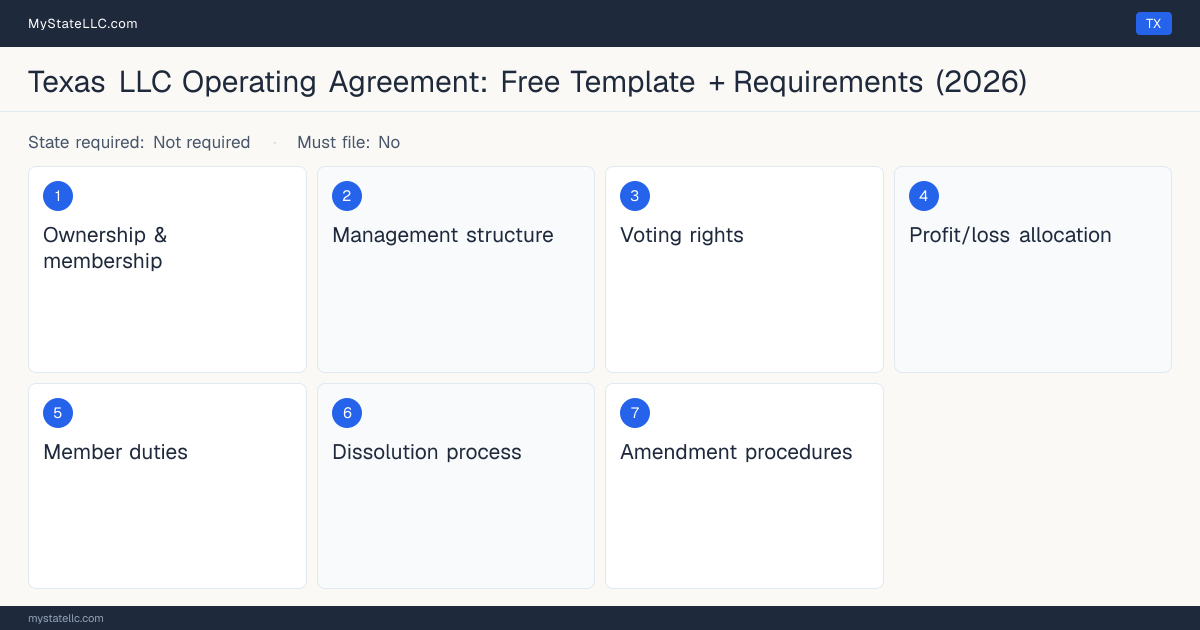
What a Texas operating agreement should contain, section by section. Source: Texas Secretary of State.
State Requirements
Required By Law
no
Must Be Filed
no
Special Rules
None beyond standard requirements
What to Include in Your Operating Agreement
Ownership & membership
Define each member's ownership percentage, capital contributions, and membership interests. This establishes who owns what portion of your LLC and prevents future disputes.
Management structure
Specify whether your LLC is member-managed or manager-managed, and outline the roles and authority of managers or managing members. This clarifies who makes day-to-day business decisions.
Voting rights
Establish voting procedures for major decisions, including what constitutes a quorum and what percentage is needed for approval. This ensures important business decisions are made properly.
Profit/loss allocation
Detail how profits and losses will be distributed among members, which may differ from ownership percentages. This prevents confusion during tax season and profit distributions.
Member duties
Define each member's responsibilities, time commitments, and any restrictions on competing businesses. This sets clear expectations and protects the LLC's interests.
Dissolution process
Outline the circumstances that trigger dissolution and the process for winding up business affairs. This provides a clear exit strategy and protects all members' interests.
Amendment procedures
Specify how the operating agreement can be modified, including voting requirements and documentation needs. This allows for future changes while maintaining proper governance.
Frequently Asked Questions
No, Texas law doesn't require LLCs to have a written operating agreement under the Texas Business Organizations Code (TBOC). However, this absence of a legal mandate creates significant practical risks for Texas LLC owners. Without a formal operating agreement, your LLC will be governed by default Texas state rules, which may not reflect your business intentions and offer minimal liability protection if challenged in court. The Texas Secretary of State doesn't require you to file an operating agreement, nor does the state impose filing deadlines for one. This flexibility is deceptive, courts increasingly scrutinize undocumented LLCs during litigation, and creditors or disgruntled members can more easily pierce your liability shield if you can't demonstrate serious governance structures. A written operating agreement establishes clear rules on member voting rights, profit distribution, management authority, and dissolution procedures, significantly strengthening your legal position if disputes arise. Without one, you're essentially relying on Texas default statutes that assume equal ownership and equal management rights, regardless of actual capital contributions. To protect your limited liability status and avoid costly disputes, draft an operating agreement immediately using a Texas-specific template that reflects your actual business structure.
Yes, you can write your own Texas LLC operating agreement, and Texas law doesn't require you to file it with the Secretary of State, giving you complete flexibility in drafting. However, your agreement should cover member contribution amounts, profit distribution percentages, voting rights, management structure, and procedures for adding or removing members, areas many self-drafted agreements overlook and that the Texas Business Organizations Code then fills with its own defaults. Without proper provisions covering member withdrawal, buy-sell triggers, and dissolution procedures, you risk costly disputes that exceed the cost of professional review. Using a state-specific template tailored to Texas requirements ensures compliance with state law while protecting your personal assets from LLC liabilities. Many template services cost $50 to $150, while attorney review runs $300 to $800, both far less expensive than litigation over ambiguous provisions. Your next step: download a Texas-specific operating agreement template from the Secretary of State's website or a reputable legal document service, customize it for your ownership structure, and have each member sign and retain copies before conducting any LLC business.
No, Texas doesn't require LLC operating agreements to be notarized under the Texas Business Organizations Code. The agreement is legally valid once signed by all members without any notary seal. However, notarization. Which costs $5 to $15 per signature at Texas notary publics. Can provide evidentiary advantages if the agreement is ever disputed in court or challenged by the Texas Secretary of State during an audit.
For most LLC owners, skipping notarization saves time and money while maintaining full legal enforceability. The practical implication is that you can execute your operating agreement immediately without scheduling notary appointments, though you should still keep original signed copies in your business records alongside your Certificate of Formation filed with the Secretary of State.
If you anticipate potential member disputes or plan to use the agreement as evidence in litigation, consider notarization despite it being optional. To proceed, have all members review and sign your final operating agreement, then store it with your corporate records.
Without an operating agreement, your Texas LLC is automatically governed by the Texas Business Organizations Code (TBOC), Chapter 101-116, which imposes rigid default rules that likely won't match your business intentions. Under Texas default law, profits and losses distribute equally among all members regardless of capital contributions, voting rights default to equal member votes, and management authority defaults to all members acting jointly, even if you intended a manager-led structure. This creates practical problems: if two members disagree on a major decision, neither can act unilaterally; if a member contributes significantly more capital, they receive no preferential returns; and if a member leaves, Texas law may dissolve your LLC entirely unless you've documented otherwise. Additionally, without a written agreement, disputes over member roles, compensation, and buyout terms often end up in costly litigation. The Texas Secretary of State's filing requirements don't mandate an operating agreement, but operating without one exposes your LLC to default rules that contradict most owners' intentions. Your immediate next step is to draft an operating agreement specifying management structure, profit distribution, voting rights, and member duties, ideally before admitting additional members or making capital calls.
Yes, you can amend your Texas LLC operating agreement at any time by following the procedures specified in your original agreement. Texas law doesn't mandate a specific amendment process, so your agreement's terms control whether amendments require unanimous member consent, majority vote, or manager approval.
Most Texas LLCs require unanimous consent for significant changes like member withdrawal rights or profit distribution, while operational matters may need only majority approval. You'll need to document amendments in writing and maintain the updated agreement with your LLC records at your registered agent's address. Texas doesn't require filing amendments with the Secretary of State unless they affect registered agent information or management structure.
This flexibility means you can adapt to changing business circumstances without court involvement, but failing to follow your agreement's amendment procedures could create disputes among members or invalidate the changes. Review your original agreement's amendment clause immediately to understand your specific requirements, then draft amendments using clear language identifying the sections modified and the effective date.
Sources
Each entry below is a document recorded in our verified Texas sources, and each entry says what the document is. Some statutory text is read from an accurate mirror rather than from the state's own host, and those say so.
See how Northwest Registered Agent, Bizee, ZenBusiness and LegalZoom, the formation services we partner with, compare on 3-year cost, BBB rating and Trustpilot score before you choose.