Create a comprehensive operating agreement for your Washington LLC with our free template and step-by-step requirements guide.
Last updated: August 2026
Washington does not legally require an LLC operating agreement, but having one protects your limited liability status and sets the rules for ownership and profits. See exactly what to include below.
Affiliate disclosure: We may earn a commission at no extra cost to you.
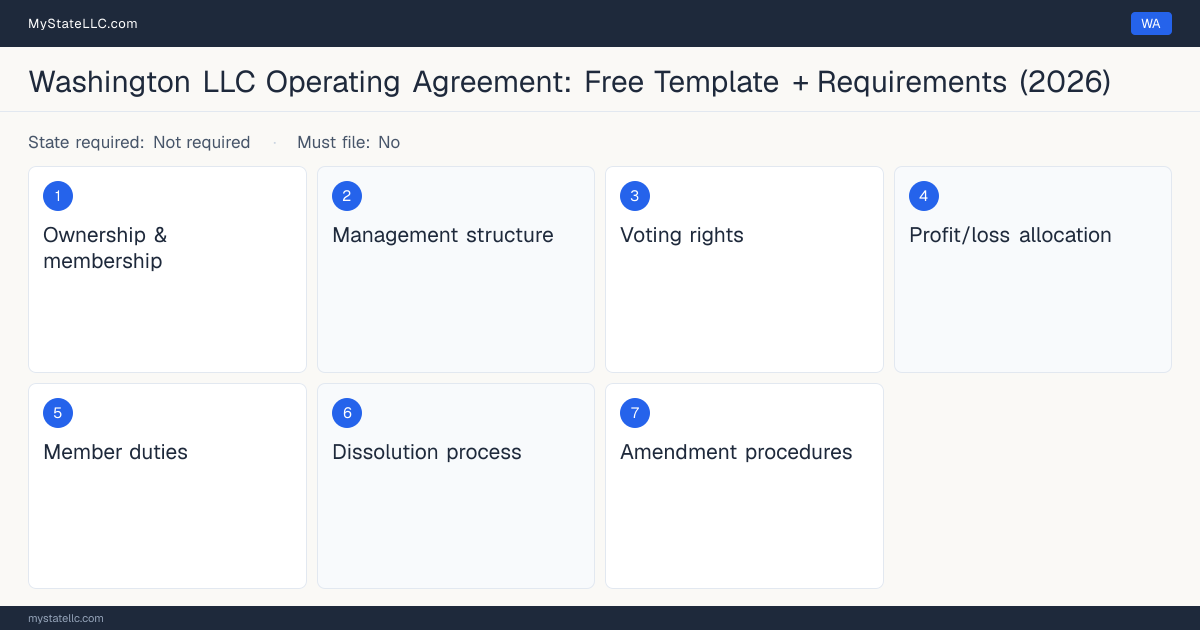
What a Washington operating agreement should contain, section by section. Source: Washington Secretary of State.
State Requirements
Required By Law
No
Must Be Filed
No
Special Rules
None beyond standard requirements
What to Include in Your Operating Agreement
Ownership & membership
Define each member's ownership percentage, capital contributions, and membership interests. This section establishes who owns what portion of your Washington LLC.
Management structure
Specify whether your LLC is member-managed or manager-managed and outline day-to-day operational responsibilities. This determines who has authority to make business decisions.
Voting rights
Establish voting procedures, quorum requirements, and decision-making processes for major business matters. Clear voting rules prevent disputes and ensure smooth operations.
Profit/loss allocation
Detail how profits and losses will be distributed among members and specify distribution timing and methods. This section matters for tax reporting and member expectations.
Member duties
Outline each member's roles, responsibilities, and obligations to the LLC. This includes fiduciary duties, non-compete clauses, and confidentiality requirements.
Dissolution process
Define the circumstances that trigger LLC dissolution and the process for winding up business affairs. This protects all parties if the business needs to close.
Amendment procedures
Establish how the operating agreement can be modified, including required member approval percentages. This ensures changes are made fairly and with proper consent.
Frequently Asked Questions
No, Washington state does not legally require LLCs to have an operating agreement. However, it's strongly recommended because without one, your LLC defaults to Washington's Revised Uniform Limited Liability Company Act (RCW 25.25), which may not align with your business structure or member intentions. An operating agreement lets you customize profit distribution, management roles, voting rights, and member buyout procedures, protecting your limited liability status if challenged in court. The Washington Secretary of State does not mandate this document for filing, but courts have upheld operating agreements as binding contracts that override default state rules. For LLC owners, this means choosing between accepting Washington's one-size-fits-all statutory framework or investing in a customized agreement that prevents costly disputes and demonstrates serious business governance. Your next step: draft an operating agreement with all members' signatures before conducting business, then store it with your Certificate of Formation records.
Yes, you can write your own Washington LLC operating agreement. Washington doesn't require you to file it with the Secretary of State or meet specific statutory formatting requirements. You can use templates, online resources, or draft from scratch as long as your agreement addresses membership interests, profit distribution, voting rights, and management structure.
However, this DIY approach carries real risks. Washington courts will enforce custom agreements according to their plain language, meaning poorly drafted provisions could create costly disputes during member disagreements or dissolution. For LLCs with multiple members, significant assets exceeding $50,000, or complex profit-sharing arrangements, consulting a Washington business attorney (typically $300 to 800 for agreement review) is prudent. It costs far less than litigation over ambiguous terms.
Your next step: Use a state-specific template from the Washington Secretary of State's website as your foundation, then have an attorney review it before all members sign and retain copies in your LLC records.
No, Washington does not require LLC operating agreements to be notarized under RCW 25.10 (Washington's Limited Liability Company statute). The agreement becomes legally valid the moment all members sign it, with no state filing or notarization requirement through the Washington Secretary of State's Business Services Division.
However, notarization offers practical advantages despite being optional. Many banks and lenders request notarized copies when you apply for business lines of credit or loans, as notarization provides third-party verification of signatories' identities. Additionally, if a member later disputes the agreement's authenticity or claims they didn't authorize their signature, a notarized document strengthens your legal position in Washington courts.
For Washington LLCs, notarization typically costs $10 to 20 per signature at most banks or notary services. This modest expense becomes worthwhile if you anticipate external financing or ownership disputes.
If you're obtaining financing or opening a business bank account, contact your lender first to confirm their notarization requirements before finalizing your operating agreement. This prevents delays in fund access or account setup.
Without an operating agreement, your Washington LLC will be governed by Washington's default LLC laws under the Washington Limited Liability Company Act (RCW 25.25). These statutory defaults treat all members as equal partners with proportional ownership rights, regardless of capital contributions or actual involvement in the business.
This creates three immediate problems. First, profit distribution defaults to equal splits among all members, even if you contributed more capital or expect different arrangements. Second, management decisions require unanimous member consent for major changes like selling assets or admitting new members, which can paralyze your business. Third, member disputes have no predetermined resolution mechanism, forcing costly litigation under Washington state courts.
The practical consequence: if a co-member wants out or disagrees on direction, you'll spend thousands resolving disputes that a proper operating agreement could have prevented. Additionally, lenders and investors view LLCs without operating agreements as unprofessional and high-risk.
Your next step is drafting or adopting a Washington LLC operating agreement immediately, even if your LLC already exists. File it with your records and ensure all members sign it to establish enforceable governance terms.
Yes, you can amend your Washington LLC operating agreement at any time by following the procedures outlined in your original agreement. Most Washington LLCs require unanimous member consent for amendments, though you can specify lower thresholds (such as majority vote) in your operating agreement itself. The Washington Secretary of State doesn't require you to file amendments to your operating agreement. Unlike Certificate of Formation changes, these remain internal documents. However, you must document the amendment in writing and retain it with your LLC records, as the Department of Revenue may request proof during audits or tax filings. If your agreement is silent on amendment procedures, Washington law defaults to requiring consent from all members. This matters because failing to follow your specified amendment process could invalidate changes, creating disputes over membership rights, profit distribution, or management authority. To amend your agreement, draft the amendment document, secure the required member signatures, and store the signed amendment with your original operating agreement and bylaws in your LLC's records folder.
Sources
Each entry below is a document recorded in our verified Washington sources, and each entry says what the document is. Some statutory text is read from an accurate mirror rather than from the state's own host, and those say so.
See how Northwest Registered Agent, Bizee, ZenBusiness and LegalZoom, the formation services we partner with, compare on 3-year cost, BBB rating and Trustpilot score before you choose.